

Ever since Eve and Adam were banished from the Garden of Eden, humankind has been obsessed with finding the fountain of youth and ways to live forever.
Western Judeo-Christian creation myths aside, scientists at local longevity startup, Revel Pharmaceuticals, have invented a method that turns back the clock on human aging at the molecular level. It’s the first proof that such an outcome is even possible in vivo; in a living organism, rather than in vitro, confined to cells or tissue in a lab dish.
Revel announced its breakthrough – conducted in an industry-academic collaboration with Calico Life Sciences and the University of Colorado – in a July paper published in Nature Communications. The document described how Revel created a novel enzyme, “CMLase,” in the laboratory through a process called “directed evolution.”
Directed evolution mimics natural selection in the lab. Scientists start with a gene for an enzyme, introduce random mutations to create a large, varied pool of versions, then screen or select for variants that best perform the desired task. The cycle is repeated over many rounds, steadily “evolving” an enzyme with properties that don’t exist in nature.
Revel then tested CMLase on human tissue. The enzyme successfully reversed build-up of damaging biological compounds that accumulate over decades in the aging body. CMLase also repaired and eliminated the injury these compounds cause.
The discovery opens the door to new medicines that target inflammatory conditions associated with aging, such as heart and kidney disease, stiffening skin, gout, arthritis and cataracts.
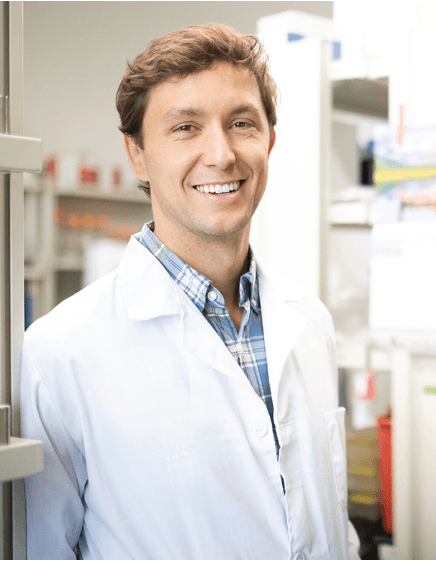
The View sat down with Chief Executive Officer Aaron Cravens at Revel’s American Industrial Center (AIC) headquarters. A University of Rochester graduate, with a PhD in bioengineering from Stanford, Cravens came up with the idea for his company at an incubator supported by Mission Bay Capital (MBC) in 2020 in Mission Bay.
A charming and self-assured 33-year-old, Illinois-raised Cravens radiates Midwestern level-headedness with millennial moxie and smarts. He fell in love with the area and chose to build Revel’s lab inside the former can factory in 2022.
“Dogpatch is a neighborhood that has an interesting entrepreneurial edge to it,” Cravens said. “You can go get coffee at Piccino, see and meet people walking out and about.”
He contrasted the community’s vibe to the “soulless skyscrapers” that’ve popped up everywhere.
“I love that AIC is still a family-owned building,” he remarked.
Cravens also appreciated AIC’s neighborhood in-a-box spirit, noting it has “everything from a climbing gym, bakery, cafe, galleries and even a hair salon.”
He’s inspired by the complex’s “collective, cool, collegiate energy” and marvels at the variety of builders, artists and creators housed there, pointing to “innovators making artificial salmon, sustainable skincare products and a guitar-making shop at AIC. These are people with passion. They do what they do every day, not for money but because they love it.”
It’s an orientation Cravens likens to “what good science” is all about and to which Revel Pharmaceuticals aspires.
Humans are composed mostly of water, up to 60 percent, with cells, tissue, blood and bone. Seventy percent of our bodies consist of structural tissue; the scaffold that holds everything together, such as collagen, elastin and eye lens proteins, known as the extra-cellular matrix (ECM). Most age-related damage accumulates in the ECM. It’s what drives aging-associated conditions, such as neuro-degeneration, heart disease, skin wrinkling, arthritis and gout.
“This is big,” commented Karl Pfleger, a longevity advocate and investor. “Revel solved a problem long considered unsolvable. Many in the anti-aging field believe rejuvenation is impossible. Even with technologies to make all cells young again, science hadn’t yet devised a way to make the extracellular matrix young again. In human tissue, Revel’s enzyme cleared more than 70 percent of the damage from an aged human artery wall and turned elderly skin back to the level of a 30-year-old’s.”
“The simplest way to put it is: the chemistry that browns toast is happening inside your body, just slower,” Pfleger clarified. “Heat turns bread golden and stiff, and you can’t turn toast back into soft bread again. The same chemical reaction runs in us over decades, blood sugars fuse to the proteins that hold our skin and arteries together, stiffening tissue in a way thought irreversible since the 1980s. That stiffening is what makes skin less elastic with age, hardens blood vessel walls, drives up blood pressure as arteries lose their flexibility. The body reads the damage as an alarm and keeps the immune system switched on; the slow-burn inflammation behind heart disease, diabetes and failing kidneys.”
“What they did is very clever. Ingenious really,” said Dr. Vincent Monnier, Case Western University professor, a pioneer in anti-aging biochemistry and scientific advisory board member to Revel Pharmaceuticals. “They used directed evolution to produce an enzyme that undoes the biochemical damage caused by substances inside the human body’s extracellular structures as we age, a phenomenon long thought irreversible.”
Twenty-six years ago, Monnier tried to do the same thing in his lab but was unable to achieve Revel’s results because the tools didn’t exist. There was no artificial intelligence. Revel employed the software AlphaFold to analyze DNA sequences of more than 50,000 microbes and compute the enzyme structures that each genetic code would create, narrowing results. AlphaFold helped Revel’s team screen 500 million enzyme variants to settle on one, which became CMLase.
Cravens compared human aging to what happens to cars.
“You can take good care of your car, put premium gas in it, avoid potholes, never take it to the shop,” he said. “After driving 200,000 miles though, your car will have undergone stress, accumulate damage and start to rust. Just like cars that rust, our bodies ‘rust.’ We can’t do anything to stop the molecular damage that happens in our bodies as we age. What we did at Revel is develop a tool to de-rust things like collagen and proteins that make up our body’s cellular infrastructure. CMLase repairs and cleans up the damage in the structures our cells live in. It’s like taking your body to the repair shop, the same way you would do for your car. Hopefully, getting your car fixed helps your car drive longer. Ultimately our work is the foundation to make medicines that help us live longer, healthier lives.”
In the next 18 months Revel hopes to take its discovery to human trial. After that, Revel intends to make therapies for specific conditions first, such as age-related eye diseases – like glaucoma and diabetic retinopathy, – kidney disease, gout and arthritis.
It’s a striking glimpse into the future of medicine, suggesting a longer, healthier human lifespan driven by insights once considered unimaginable.
Revel’s work is supported in part by the National Institute of Health’s National Institute on Aging. The company receives funding from German-based Kizoo Technology Ventures and Starbloom Capital, among others.
All have a deep commitment to “transformative,” longevity science, Cravens emphasized, and “biology-first approaches to age-related disease.”
 Rebekah Moan
  Danny Pham
  Jessica Zimmer