
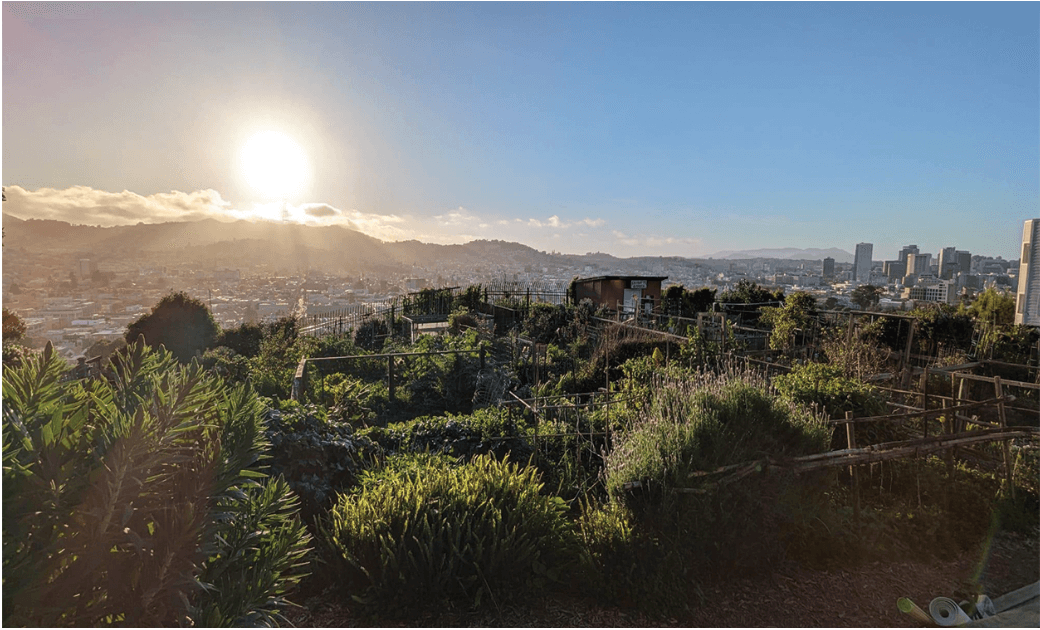
Situated at the corner of 20th Street and San Bruno Avenue, alongside a quaint red bench and picnic table, are 53 highly sought after urban garden plots encircled by a rustic wooden fence Founded in the early-1970s, Potrero Hill Community Garden has a waiting list of almost 400 San Franciscans eager for a small piece of dirt that offers views of the Golden Gate Bridge, Sutro Tower, Twin Peaks, and Downtown San Francisco.
“I had been waiting for six to seven years,” remembered Jessica McCall. “When I got a call for a spot available, my family and I went over, and we were charmed by the place.”
“It took us seven years,” said Mark Heinbach. “I used to live on 22nd and De Haro, we put our name in, and seven years later we finally got a plot. We just moved to the Mission, so it wasn’t that far, just a 10 minute walk up the hill. That was pre-pandemic. I think the plots turned over a little quicker post-COVID, but the list used to be two pages long instead of just one.”
Most plots, 31, are tended by Potrero Hill residents. A dozen are cultivated by Mission or Bernal Heights inhabitants. The rest are reserved by San Franciscans living in Hayes Valley, South-of-Market, Haight-Ashbury, Bayview, Financial District, Castro, Mission Bay, Twin Peaks, and Stonestown.
“There are 391 persons on the waitlist,” said Berille Legrand, the Garden’s list manager. “We are now offering plots to people who signed up in 2018, and we have four vacancies so far in 2024. Only about one out of five people is usually still interested in getting a plot in the garden when I reach out to them. If people want to sign-up, they need to contact the Park and Recreation department directly to have their name added to the waitlist.”
San Francisco Recreation and Parks Department (SFRPD) owns and helps maintain the land on which the garden sits, along with more than 40 percent of community gardens in the City under the Urban Agriculture Program. The department publishess a 31-page policy book for community gardens which identifies good practices and operating rules. For example, gardens should have regularly scheduled workdays and annual dues.
The San Francisco League of Urban Gardeners (SLUG) previously managed many of the City’s urban commons along with SFRPD-owned plots. SLUG dissolved in 2003 after an Office of the Controller report found the nonprofit had mismanaged municipal funds, with improper expenditures. Former SLUG Executive Director Mohammed Nuru, who was later installed as the head of San Francisco Public Works by Mayor Ed Lee, was tied to the scandal. Nuru is presently incarcerated in the United States Penitentiary in Lompoc, California, convicted of committing fraud while leading Public Works.
“I have been at the garden since 2012,” Legrand recounted. “Some people do not last a year and some a very long time. The difference is big. It is almost as if some people make it, and some don’t. Gardening takes time and work all year long in the Bay Area.”
Marianne Horine is one such enduring horticulturist. She’s been a Potrero garden member for 30 years, during which she gained friends and served twice as garden coordinator.
“I was the first female GC in over 10 years when I came on, and I had a good run. I was with the original members for so long and they’re the ones that taught me. We had two of our founding members until they passed away in 2016. The other people have moved away. My favorite garden buddy Lee and I would spend Saturday’s gardening, but she also moved to Maine to start a flower farm, so I miss her.”
Horine’s most recent stint as coordinator was from 2014 to 2017, during which she, along with Sheree Kaslikowski, won the Unsung Hero Award from San Francisco Beautiful, a nonprofit that advocates for “civic beauty, neighborhood character and accessible public art for all in San Francisco.”
The garden coordinator role was replaced by a Steering Committee when Horine’s tenure ended. Members must enlist in the Committee within the first four years of joining, and stay on for at least two years, with the option of engaging longer. Heinbach, McCall, and Legrand serve on the Committee as member, secretary, and list manager, respectively.
Membership dues are $25 a year, which helps pay for compost, topsoil, and mulch. There are two mandatory in-person workdays annually, for general upkeep, remulching of common areas, and weeding.
“I really enjoy walking up here often,” said Heinbach, who is in his third year at the garden. “It’s very nice and quiet, and a nice way to get into the dirt. It’s early, but we’re growing a lot of herbs like rosemary, thyme, oregano, and some sage. The raspberries are starting to bud and getting bigger now. I plan to put in some tomatoes, a blackberry bush, and a blueberry plant. You run into people from the garden out in the City and it’s always nice to say hello.”
“I love the garden, it’s a great place and I’ve seen it change over the years,” said Horine. “I still have my plot and I live right down the street so it’s so easy to come down.”
“I wish we’d have more organized rules, and that people would make it more of a priority,” said a gardener who wanted to remain anonymous. “It would be nice if plots could turnover faster to give more people an opportunity, like younger members that want to come in and make a change and make it more beautiful. I wish there was more of a community. Some people just don’t know how lucky they are.”
Top: Potrero Hill Community Garden. Photo: Chaitanya Tondepu
 Jessica Zimmer
  Tracy Tanner