
“Racial segregation does not just happen; it is made,” wrote Ira Katznelson, author of Fear Itself.
The Home Owners’ Loan Corporation was established by the U.S. Congress in 1933 to address an avalanche of home foreclosures triggered by the Great Depression. Over three years, HOLC refinanced more than one million residences. Home ownership rose dramatically, as new buyers secured low-interest, long-term loans.
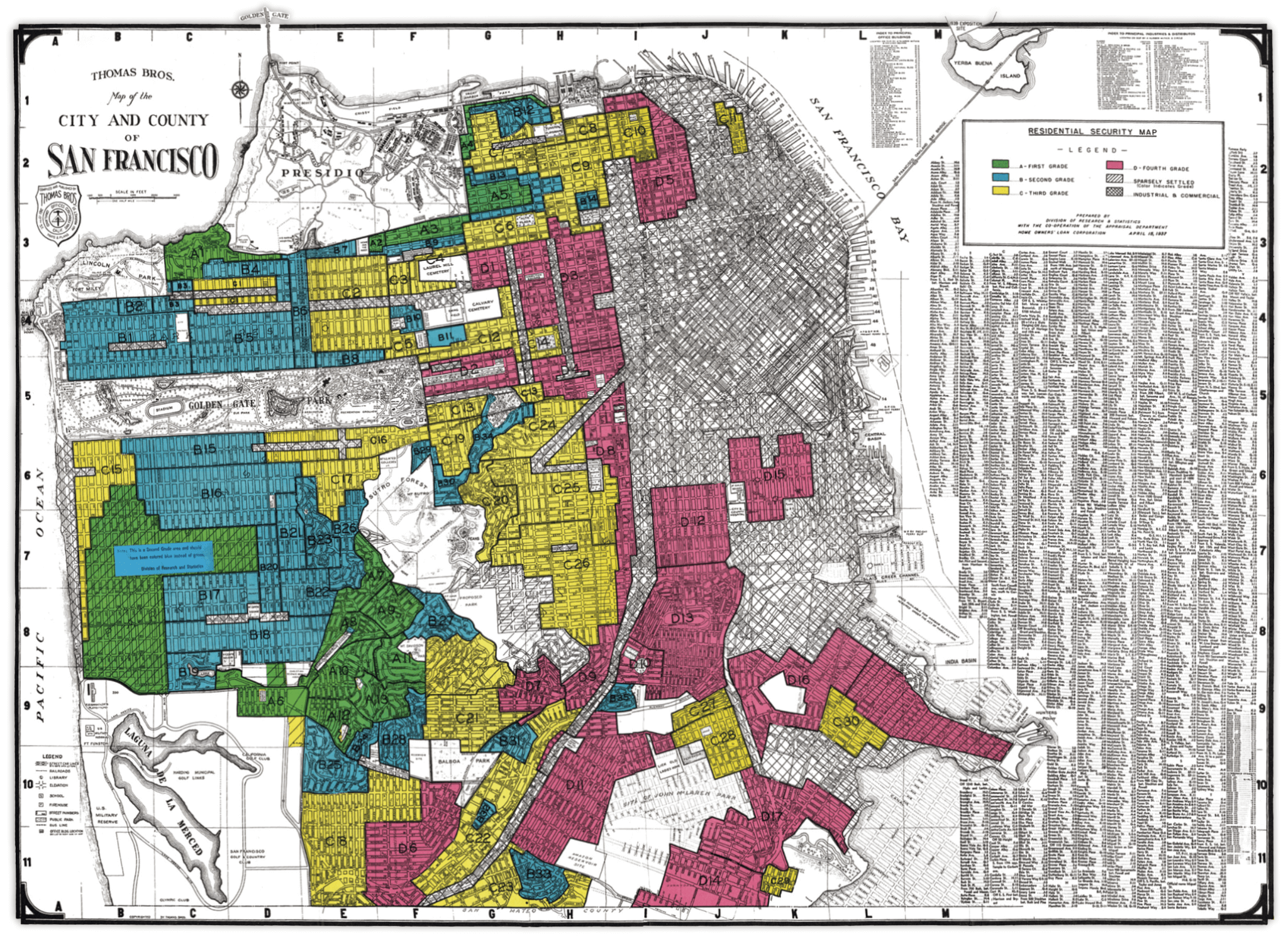
A HOLC ‘Residential Safety Map’ rated San Francisco neighborhoods for federally financed low-interest loans. Similar charts were made for 240 cities across the country, classifying communities into four investment categories based on ‘favorable’ or ‘detrimental’ influences, partially determined by race and ethnicity. Private banks adopted HOLC’s metrics.
Green ‘A’ neighborhoods were categorized as ‘hot spots where good mortgage lenders are willing to make their maximum loans’. Blue ‘B’ were less desirable but ‘still good’. Yellow ‘C’ were in decline. Red ‘D’ were in full decline: lenders beware.
‘Redlining’ describes this approach to segregation, where the ‘threat of infiltration of foreign-born, negro, or lower grade population’ was deemed too risky for investment. Most of Potrero Hill, D15, on the map, was redlined.
Red D15 residents were described as,
…working class factory workers, laborers, and artisans, with incomes from $1,000 to $2,000. There is quite a concentration of ‘red’ (i.e. Communist) Russians and other foreign elements in the area…Light and heavy industrial districts completely surround the area, and stockyards and meat packing plants situated nearby are the source of unpleasant odors when the wind is from their direction, which, fortunately, is seldom…The area is said to offer some interesting possibilities for future development, but under existing conditions loan commitments are made with extreme care by the comparatively few mortgage institutions which will lend at all in the area.
Blue B5 residents were labeled,
…businessmen of the junior executive type, highly skilled laborers, and ‘white-collar’ workers, having an income range of from $2,000 to $5,000. There are no adverse racial concentrations in the area…There is a good, stable demand for property in this area.

The federal Housing Act of 1937 was designed to clear slums and provide low rent housing for ‘the deserving poor’, mostly white people affected by the Great Depression. Potrero Terrace, 469 units of low rent housing, was built in 1940. Thousands of Black people moved from Southern states to the Bay Area to work in World War II industries. By 1945, 40 percent of public housing residents were African-American; 85 percent by the 1960s.
Public housing in San Francisco rented apartments based on a ‘neighborhood pattern policy’ aimed at maintaining the area’s racial mix. This approach was ruled ‘an arbitrary method of exclusion’ in 1954 and the City’s public housing was supposed to be desegregated.
In 1950, Enola Maxwell and her two children came to San Francisco from Louisiana with her mother, who worked in the shipyards. They lived in the Carolina Street Public Housing projects, now San Francisco International High School. According to Maxwell, at that time Black home ownership on Potrero Hill wasn’t possible. When she tried to buy a house, realtors turning her away, adding that “Now, things have changed. You can live anywhere, but you just don’t have the money”. Maxwell became Potrero Hill Neighborhood House director in 1972. She died in 2003, at the age of 83.
The Federal Fair Housing Act of 1968 banned redlining, but the impact of housing discrimination continues in wealth and health disparities, crime, underfunded schools, and pollution found in communities historically subjected to the practice.
 Moumita Chakraborty
  Jessica Zimmer
  Mark Steensland