
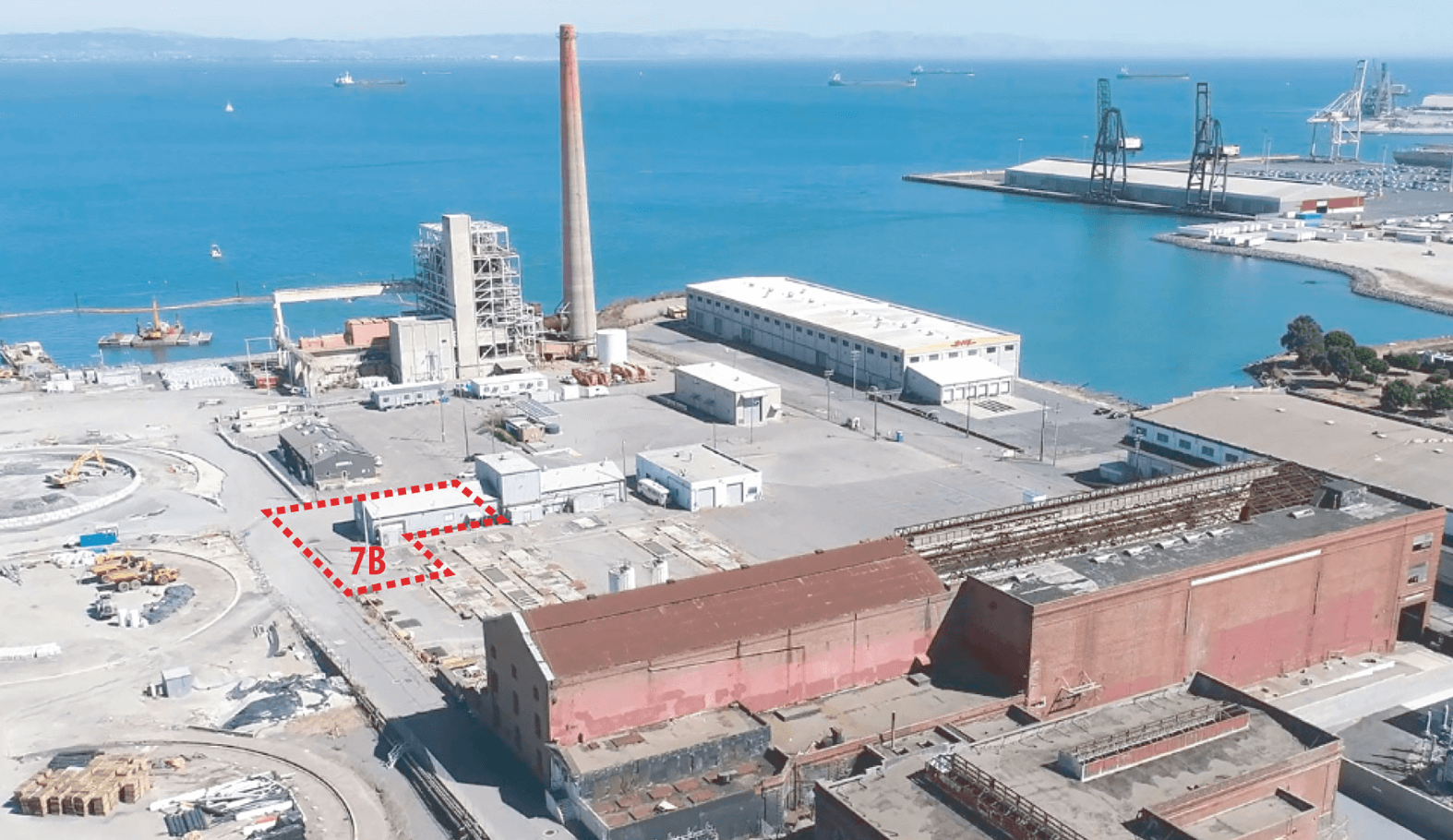
Last fall at Power Station, a 29-acre mixed-use project in Dogpatch, shovel hit dirt to inaugurate development of The Maxwell, a 105-unit affordable apartment complex. The building is named after Sophenia “Sophie” Maxwell, who served as District 10 Supervisor from 2001 to 2011. Maxwell is the daughter of Enola Maxwell, founder and former director of the Potrero Hill Neighborhood House.
With support from the Potrero Power Plant Citizens Task Force, on which John Borg, Philip De Andrade, and Steven Moss, among others, served, Sophie Maxwell was instrumental in shuttering the former Pacific Gas and Electric generating station in 2011.
The Maxwell will take roughly two years to build, typical for projects of its size. The concrete pad and infrastructure for the building is in place, according to Larry Mazzola, Jr., San Francisco Building & Construction Trade Council president. The John Stewart Company will be the nonprofit housing operator for The Maxwell.
“The Maxwell will put hundreds of building trades members to work,” said Mazzola. “In the big picture, this first building represents an investment in San Francisco and local unionized construction workers during a time when most are busy playing politics and talking doom loops. Once the horizontal work is done, members of all crafts will be on-site to make this workforce housing, a testament to skilled and trained members of the trades.”
According to Dan Dunmoyer, head of the California Building Industry Association, high construction wages are “cost prohibitive other than in the highest end communities. It just doesn’t pencil in 85 percent of the state.”
Power Station is expected to ultimately consist of 2,600 residential units, 30 percent of which will be offered below market. Under a municipal development agreement construction can extend as long as 30 years, though the project will likely be completed sooner.
“Power Station will be built in several phases over the next decade and beyond,” said PJ Johnston, Power Station spokesperson. “Phase One is under way now. Our original phasing plan had a single residential building in the first phase. Now our revised first phase has three residential buildings with more than 730 units, The Maxwell being the first. This is more than double the housing originally planned for the first phase.”
“Power Station is incredibly important to the future of the City. It will bring everything the City is looking for in a neighborhood; affordable housing, commercial space, waterfront access, and protection from sea level rise through a portion of seawall,” said Judson True, Mayor London Breed’s director of housing delivery. “Power Station is in an area where the City is seeing more growth and will continue to grow substantially. The City is watching how construction and interaction with local residents unfolds at Power Station. We’re looking to see what other developments can accomplish.”
“The first piece of Power Station will benefit members of the community. That’s symbolic and literal. We look forward to seeing more affordable units come to District 10 and the City,” said District 10 Supervisor Shamman Walton. “Currently, there’s a lot of construction here. My hope is that watching Power Station go up will show other areas of the City what can be accomplished with a large development.”
Rentals of the units, once finished, will be processed by the Mayor’s Office of Housing & Community Development.
“By law, the only preference allowed is for residents of District 10. “Neighborhood Preference” is officially City policy as passed by the San Francisco Board of Supervisors,” said Johnston, referring to an ordinance that took effect in 2016.
According to Johnston more than 30 San Franciscans, a dozen of whom are from District 10, presently work at Power Station.
CityBuild, an Office of Economic and Workforce Development (OEWD) program, offers a 12-week pre-apprenticeship and construction skills training at City College of San Francisco’s (CCSF) Evans campus, and connects construction workers who are City residents with job opportunities. CityBuild Academy, the training program, provides stipends and support services to its students, including paying for uniforms, tools, and union initiation fees.
As construction progresses additional D10 residents could be employed, said Dion-Jay Brookter, chief executive officer of Young Community Developers (YCD). YCD is negotiating with Associate Capital to hire more D10 residents. CityBuild funds YCD as part of a violence prevention program, and to refer candidates to CityBuild Academy. YCD directs residents who are work-ready and building and construction trades union members to CityBuild for jobs.
Power Station is the first development in San Francisco to use an Enhanced Infrastructure Financing District (EIFD), which captures incremental property tax revenue that’d otherwise go into the general fund to pay for infrastructure. “Incremental” consists of new property duty income that’ll be generated by the development above what was collected prior to its existence. The EIFD will fund roads, utilities, and other substructure.
“Since the COVID-19 pandemic began, the economic climate has made it hard to get projects completed. Interest rates are high, and rents are relatively flat. Inflation and labor costs have pushed up construction costs. If the EIFD works for Power Station, we want to replicate that success at other large projects in the City,” said Leigh Lutenski, OEWD deputy director of joint development.
Lutenski added that an EIFD might be helpful for Balboa Reservoir, located next to CCSF’s main campus in Ingleside, India Basin in Bayview-Hunters Point, and ParkMerced, adjacent to San Francisco State University in southwest San Francisco.
“The idea is to keep all parties who initially supported the use of this tool involved long-term. These include the Mayor’s Office, the Controller’s Office, and the District 10 Supervisor. Then there will be collaborative efforts to ensure the infrastructure is completed and is high-quality,” said Theodore Conrad, OEWD project manager.
The predecessor of EIFDs were local redevelopment agencies (RDAs), created in 1945 with passage of the California Community Redevelopment Act. RDAs were supported primarily by federal funding until 1952, when state Proposition 18 established tax-increment financing for RDAs. RDAs enabled local governments to declare an area blighted and distribute growth in property tax revenue in the area to assist with development. Over the decades, critics became concerned that RDAs wasted funds and abused the power of eminent domain. In 2011, the California Legislature dissolved the state’s nearly 400 RDAs.
In San Francisco, the Office of Community Investment and Infrastructure (OCII) became the successor to the former San Francisco RDA. OCII is responsible for development in Mission Bay, Transbay, and Hunters Point Shipyard/Candlestick Point. In 2015, then-California Governor Jerry Brown signed Senate Bill 628, allowing a city or county to create an EIFD.
J.R. Eppler president of The Potrero Boosters, a neighborhood organization that represents Potrero Hill and Showplace Square, said the fact that the first building is affordable housing speaks to Associate Capital’s commitment to low and middle-income residents.
“We’re now looking forward to the beginning of construction of public space at Power Station. The development is slated to have seven acres of open space,” said Eppler.
Katherine Doumani, Dogpatch Neighborhood Association president, serves on the five-member Public Financing Authority No. 1 (PFA), which manages the Power Station EIFD. She was nominated for the position by District 3 Supervisor Aaron Peskin and confirmed by the San Francisco Board of Supervisors. Seat 1 is held by District 1 Supervisor Connie Chan, Seat 2 by District 7 Supervisor Myrna Melga, Seat 3 by Walton, and Seat 5 by Potrero Dogpatch Merchant Association president Keith Goldstein. Peskin is the alternate for Seats 1 through 3.
“This groundbreaking represents all the years of effort the community has put in to help make this a reality. We’ve learned about important aspects of the project, like the cleanup required due to contamination by PG&E and the need for protection from sea level rise, along with the developer,” said Doumani.
“It’s likely that Power Station will enjoy accelerated results and be a safer workplace. This has historically been true for projects in the City with a high degree of union involvement,” said Rudy Gonzalez, secretary-treasurer for the San Francisco Building & Construction Trades Council.
Just north of Power Station, Brookfield Properties continues to develop Pier 70, a 28-acre mixed-use waterfront development in Dogpatch, which broke ground in 2018. Brookfield Properties has constructed new infrastructure and street grid, increased the site’s grade for sea level rise protection, and restored historic Building 12, a 150,000+ square foot structure at 180 Maryland Street which previously served as a shipbuilding hub.
Brookfield Properties has eight signed leases for Building 12, including Standard Deviant Brewing, a classic brewery and pub, Breadbelly, an Asian American bakery and cafe, and Scuderia, a motorcycle shop, along with artist studios and nonprofit organizations. The developer is recruiting additional tenants and holds events like concerts onsite.
“New neighborhoods and parks being built along the waterfront are transforming former industrial sites into places that build upon unique manufacturing attributes. These offer opportunities for the creative community to expand,” said Tim Bacon, senior director of development for Brookfield Properties.
Pictured, top: The red outlines where The Sophie Maxwell Building will be erected at Power Station. Photo: Courtesy of Leddy Maytum Stacy Architects
 Steven J. Moss
  Tamala Motta
  S Anne Steinberg