

Nestled in a walkway outside Uber’s Mission Bay headquarters at Pierpoint Lane and Bridgeview Way is a tall, highly reflective serpentine structure that bounces sunlight from its geometric, shiny, stainless-steel tiles. The installation is roughly three and half stories tall. Its shape is akin to a futuristic spaceship composed of three slithering snakes coiling up toward the sky. The silver exterior contrasts with colorful interior tiles, presenting visitors with an entirely new vantage point and light quality when standing inside the sculpture looking up.
“Orbital” is by FUTUREFORMS, an award-winning art and design studio that uses geometry, light, and shadow techniques to create impactful art pieces for urban spaces. Founded in 2009 by artists Jason Kelly Johnson and Nataly Gattegno, FUTUREFORMS describes its art as “experiential, playful, integrated and engaged with its context, but also strives to present itself as an identifiable element in the built landscape,” according to its website.
The studio seeks to enliven urban environments by giving passersby a way to engage with, or pause to consider, each piece. For instance, “Orbital’s…dynamic form evokes an era of rapid change and uncertainty, while also inspiring curiosity and playful interaction,” according to its description.
Johnson and Gattegno married after meeting while undergraduates at Princeton University’s School of Architecture. Their academic backgrounds influence the studio’s approach to its work.
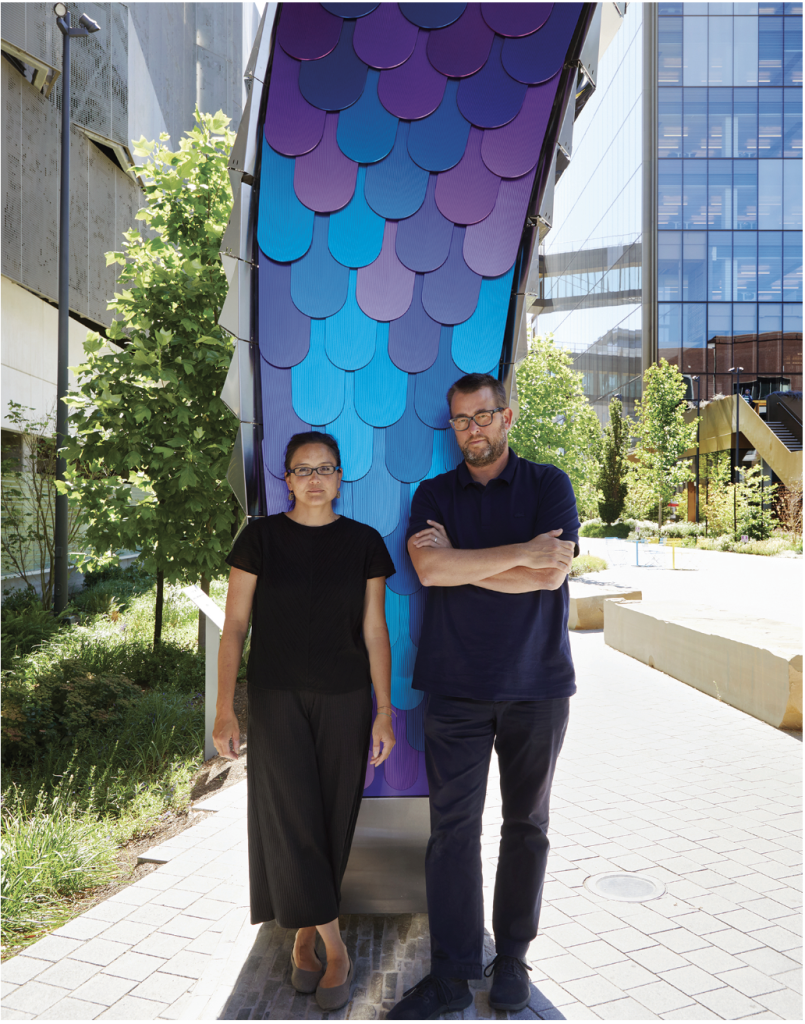
“We were both educated as architects. In our early careers we worked in architecture firms, but when we began collaborating it became clear that our interests were more expansive, said Johnson. “We started working together over 20 years ago and deliberately steered our practice to explore the intersections of public space, art, architecture, and technology. We also shared a common interest in exploring emerging design and fabrication methods using computational tools.”
Those computational tools include cutting-edge design software, computer numerical control (CNC) machining, laser cutting equipment and industrial robotic arms which can be seen throughout FUTUREFORMS’ studio inside the American Industrial Center at 2325 Third Street, where conceptualizing, designing, and building takes place.
“We’re obsessed with the details of things. I think some things get lost when they’re made entirely elsewhere, and you have no kind of connection to it. We’re always experimenting with different ways to design and make, and we like to do as much as we can in-house in San Francisco,” said Johnson. “All of this has guided how and why we work today. What emerged from all of these years of experimentation is not so much an aesthetic or a style, but more of a way of approaching the world and a creative process.”
The Dogpatch and Potrero Hill neighborhoods have played a large role in nurturing the couple professionally and personally.
“In particular, the overlapping creative communities of the American Industrial Center and the California College of the Arts have been incredibly inspiring over the years,” said Johnson.
In addition to founding and running FUTUREFORMS, Johnson and Gattegno are full-time professors at the California College of the Arts, where they teach courses on architectural design.
Minnesota Street residents, the two have been involved with local organizations and causes over the years. Johnson is on the board of the Green Benefit District, which aims to bolster funding, governance, advocacy, and volunteerism to create greener urban spaces in Dogpatch and Potrero Hill, and recently joined the Museum of Craft and Design’s board. He led installation of the public red chairs and tables in Woods Yard Park to help activate the space. Gattegno newly joined the board of Friends of Jackson Park, which fosters community support and advocacy to renovate that commons.
The studio’s latest sculpture being developed for a San Francisco location, “Metamorphosis,” consists of a series of stacked spherical forms that amplify light patterns onto neighboring surfaces through a laser-cut exterior. Supported by the Potrero Gateway Project, a community initiative to improve derelict space around and under the U.S.-101 freeway, the art piece will be installed between San Bruno, Vermont, and 17th streets early this summer.
FUTUREFORMS public art projects are displayed in Tennessee and Florida, as well as other places. All share the studio’s futuristic, ultramodern, and architectural design aesthetic. “Cosmos,” installed in Sunnyvale, California, is a stainless-steel shade canopy that resembles a tree made from origami-like tiles. “Lightweave” is suspended in an overpass in Washington D.C.’s north of Massachusetts Avenue neighborhood and translates ambient sounds into dynamic auroras of patterned LED light. FUTUREFORMS is presently developing works to be erected in Las Vegas and Los Angeles.
“Today, our studio is involved in many overlapping creative pursuits including public art, fine art, furniture, consulting, and arts master planning. We are lucky to have an incredible group of talented and dedicated staff that keeps the studio and shop humming,” said Johnson.
 Steven J. Moss
  Tamala Motta
  S Anne Steinberg