
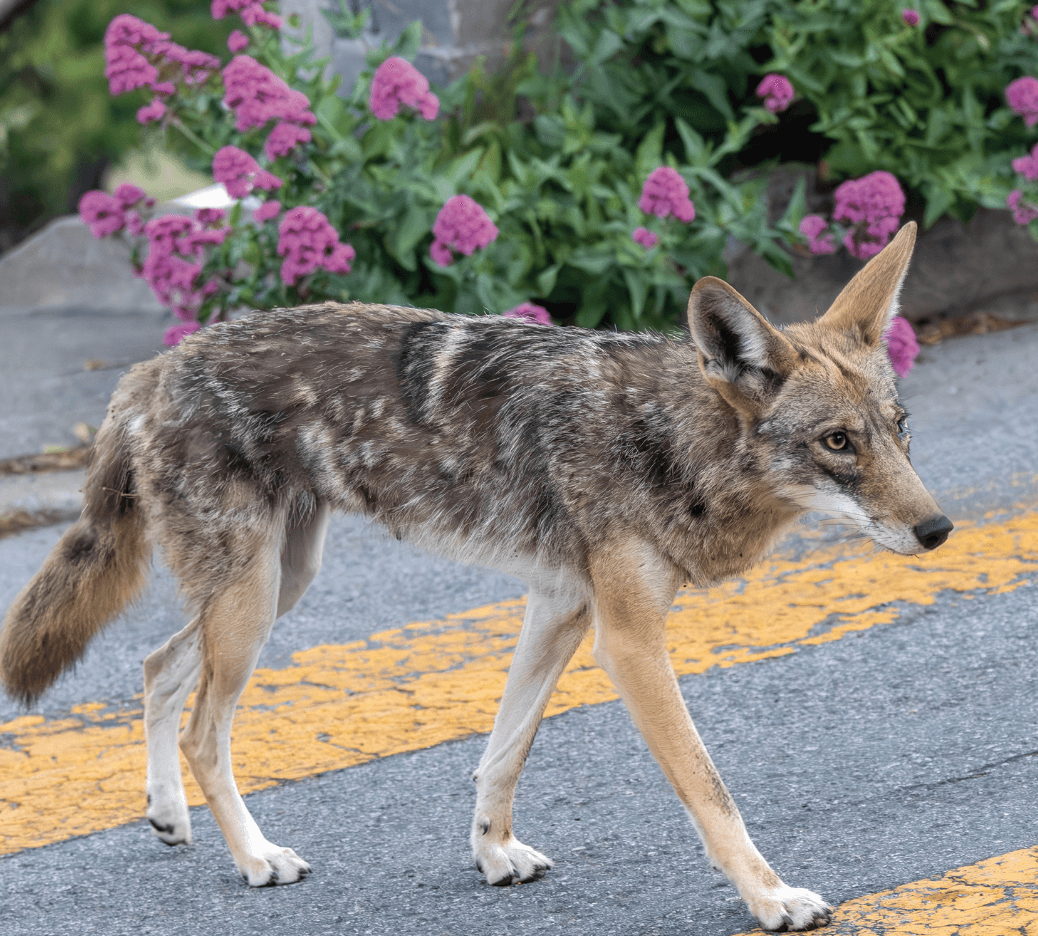
San Francisco is home to an estimated 100 coyotes, some of which frequent Starr King Open Space and the area around Potrero Hill Recreation Center. Although human-animal interactions are generally peaceful, in June a coyote bit a child at a San Francisco Botanical Garden summer camp.
“There have been reports of coyotes in virtually all our parks around the City, though “hot spots” change from year to year. When there is a known or suspected den, the area around the den is closed,” said Tamara Aparton, Recreation and Park Department deputy director of Communications and Public Affairs.
Christine Wilkinson, a postdoctoral researcher in environmental science at the University of California, Berkeley and the California Academy of Sciences, who coordinates Bay Area Coyote, a website that links to databases of coyote sightings, said there are more coyotes denning in the western than the eastern part of the City.
“Coyotes traverse through several parks in Bernal Heights. You can often hear coyote yips and howls in Glen Canyon and Twin Peaks, among other places,” said Wilkinson.
A family unit consists of an alpha male and alpha female, who typically travel with pups and often yearlings born the prior year. Most yearlings eventually disperse from the City southward. Coyotes keep non-family members out of their territories.
“One of those families lives in the Potrero Hill-Dogpatch area. This family at present consists of an alpha male and an alpha female, the parents, and three pups born this year. No yearlings remain. The parents exhibit protective denning behavior extending a good one-fourth mile radius and more from the den,” said Janet Kessler, who has been documenting coyotes in the City for 17 years.
Coyotes sometimes relocate their dens for health or safety reasons. The Potrero family has moved their den once this denning season, which lasts from April until the fall.
RPD advises people to avoid coyotes, especially where there might be dens and pups. Pets and their food should be kept indoors at night, garbage secured, and water not made available through lawn and backyard fountains, ponds, or pools. Feeders and gardens that attract birds and rodents can similarly entice coyotes, which can climb fences to enter yards. Coyote rollers – long smooth aluminum tubes that spin – can be installed to prevent the animals from ascending into plots.
Restaurant leftovers shouldn’t be left in parks at night, nor traps set for rodents that contain poison; coyotes can get sick from feeding on poisoned animals.
To deter coyotes from approaching people can clap, yell, blow whistles, and throw stones near but not at coyotes.
According to Kessler, San Francisco is home to roughly 20 coyote nuclear families living on “exclusive” territories that average two square miles. Coyotes frequent every part of San Francisco except Downtown.
“Coyotes will try “messaging” dogs to leave through body language and eye contact. When that doesn’t work, they’ll up the ante by charging at and nipping the dog’s rear end, cattle-dog fashion,” said Kessler.
“A dog owner should take their pet to a vet for treatment if a coyote bite breaks skin. All licensed dogs in the City should be protected against rabies. Dogs must be current on rabies vaccinations to obtain a San Francisco dog license,” said Deb Campbell, San Francisco Animal Care and Control spokesperson.
In 2023, SFACC reported that there were 12,454 licensed dogs in the City, a number that rose to 13,017 this year.
“There are far more dogs in San Francisco without a license, but we don’t know how many,” said Campbell.
According to the San Francisco Department of Public Health (DPH), since 2023 the rabies vaccine has been administered 18 times related to domestic animal bites, none associated with coyotes or wild animals. DPH couldn’t confirm or deny whether the child bitten in the San Francisco Botanical Garden had a rabies vaccine because of patient protections.
Coyotes in California fall under California Department of Fish and Wildlife (CDFW) jurisdiction. After the June Botanical Garden incident, CDFW worked with the U.S. Department of Agriculture (USDA) in an unsuccessful attempt to trap the animal that bit the child. USDA employees then shot the coyote that attacked the youngster as well as two others.
“We have every expectation that the territory of the coyotes that were euthanized will be filled again. That doesn’t mean the incoming coyotes will be aggressive,” said Captain Patrick Foy of CDFW’s law enforcement division.
According to Brendan Lange, Gardens of Golden Gate Park director of advancement, the summer camp didn’t relocate activities away from the area where the child was bitten. As of mid-July, coyote-related closures in municipal spaces included the two ballfields at St. Mary’s Park in Bernal Heights and the dog play area at Mountain Lake Park at 111th Avenue. Throughout the rest of Mountain Lake Park, dogs must be leashed.
Kessler, among others, disapproved of the decision to euthanize the coyotes. Others supported the action.
“There are strong opinions on both sides,” said Campbell.
Wilkinson’s research indicates that leash laws and securing attractants greatly help minimize negative interactions.
“The data indicate coyotes in less urbanized areas, like the Presidio, consume more natural sources of food than coyotes in more urbanized areas like Bernal Heights. We are still analyzing the data to determine differences regarding stress,” said Tali Caspi, a Ph.D. student in ecology at the University of California, Davis.
Dr. Christopher Schell, assistant professor in the Department of Environmental Science, Policy, and Management at the University of California, Berkeley, said it’d be difficult to remove coyotes from the City. The animals are evasive. They travel on roads like Highways 101 and 280, which aren’t walled off.
The animals help nurture biodiversity.
“When a carnivore eats a wide range of prey, that provides room for more species of small animals to exist here. Coyotes also help maintain plant populations. Larger populations of small herbivores would take out more introduced and native plants,” said Schell.
Schell added that coyotes are “ecosystem sentinels,” species whose biological outcomes are symptomatic of environmental quality. Coyotes usually live and hunt in green spaces. Spots where there are few coyotes coincide with where people lack access to nature. Highways and polluted places segregate and separate people based on race and income. These infrastructural factors also limit coyote movement and establishment.
“Coyote presence and health tells us a great deal about community health, the respect we give nature, and how inequities shape nature. Coyotes and other wildlife reflect our actions,” said Schell.
Report a coyote sighting at San Francisco Animal Care and Control (https://www.sfanimalcare.org/living-with-urban-wildlife/coyote-sightings/) or Bay Area Coyote (https://bayareacoyote.org/). Learn more about coexisting with coyotes at: https://www.sfanimalcare.org/living-with-urban-wildlife/coyote-sightings/. Understand San Francisco Recreation and Parks’ response to coyotes at: https://sfrecpark.org/1399/Urban-Wildlife.
Top: Photo courtesy of Janet Kessler / coyoteyipps.com
 Rohit Prasanna
  S Anne Steinberg
  Mark Steensland