
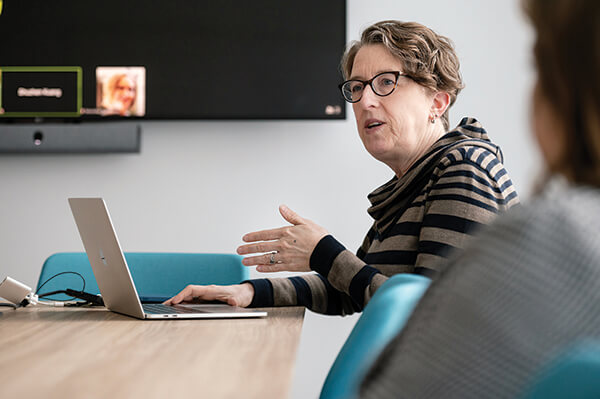
Most mornings, Katie Pollard walks from her Connecticut Street home to her Owens Street laboratory; a pleasant commute that bridges two worlds. At one end, neighbors chat over coffee, plan movie nights, and share garden tips. At the other Pollard and her team use artificial intelligence to decode the fundamental language of life itself.
“We’re trying to teach computers how to read DNA. The goal is to predict who’s at risk for disease and how to stop it before it ever happens,” said Pollard.
Pollard, one of the world’s leading scientists in computational genomics, directs the Gladstone Institute of Data Science & Biotechnology and is a University of California, San Francisco professor. Her journey into the genome began in 2001, while she was a graduate student in the Division of Biostatistics at the University of California, Berkeley. That year, the human genome was sequenced for the first time; an event that marked the beginning of what would become her life’s work. At Berkeley, she began developing computer programs to decode how DNA functions, evolves, and breaks down in disease.
Pollard was the first scientist to compare human and chimpanzee genomes end-to-end, a breakthrough that revealed a surprising outcome: our protein-coding DNA, the blueprints for our physical selves, are nearly identical to that of our primate cousins. She discovered that what makes us different isn’t what we’re made of, but how our bodies use those building blocks.
“Our uniqueness comes from how cells turn proteins on and off; when, where, and for how long,” she explained. “And that same principle applies to many diseases.”
Rather than “broken” genes, most illnesses are caused by the misfiring of otherwise normal ones. A protein that turns on in the wrong organ or at the wrong time can wreak havoc. Understanding how this regulation happens is Pollard’s main challenge.
“Our lab doesn’t use off-the-shelf AI,” she said. “Those models are good at summarizing what we already know. But to make new discoveries, we need models that can actually predict how DNA behaves.”
Deploying machine learning techniques like those in self-driving cars or language translation, her lab trains custom AI systems to spot patterns across billions of DNA letters. These models aren’t just searching for previously known, easily detectable genetic errors; Pollard’s AI looks beyond these to uncover hidden, less obvious causes of disease which could open up new frontiers in prevention and treatment.
“If we can read the genome well enough, we could one day predict a person’s disease risks from a simple, inexpensive DNA test,” Pollard said. “And maybe even treat those conditions before they start.”
Though Pollard’s professional life involves working on the cutting edge of modern medicine, her everyday life is grounded in Potrero Hill, her home since 2008.
“I moved here when I opened my lab at Gladstone Institutes,” she said. “I immediately fell in love with the views, the community, and the fact that I could walk to work.”
She’s a trusted authority when a neighbor wants to talk through a health article or make sense of a confusing medical headline. Though she’s not a medical doctor, her deep knowledge of UCSF’s health system, both as a researcher and as a member of its insurance coverage, makes her a valuable resource.
“I enjoy helping people find the care they need or track down good information,” she said. “It’s one way science becomes more real, when it touches people’s lives directly.”
On her block, affectionately dubbed the “Connecticut Deadenders,” neighbors organize movie nights, holiday caroling, and annual garage sales. They look out for each other – sharing tools, trading parenting tips, and building gates between yards to enable uphill neighbors to cut through.
“It’s the kind of community where you feel supported,” Pollard said. “That spirit really shapes how I think about science, and it reminds me that we’re doing this for people.”
According to Pollard, who travels throughout the country for her work, San Francisco is a center for invention.
“Right in Mission Bay, scientists have figured out how to turn a skin cell into any cell type in the body. We can edit DNA in those cells. And my lab uses those breakthroughs to train computers that can predict the causes of disease and possible treatments,” she said.
UCSF, Gladstone Institutes, and nearby biotechnology firms comprise a global hub for biomedical innovation. With AI giants like OpenAI and Anthropic also in the area, opportunities for collaboration across disciplines are growing.
“It’s exciting to be at this intersection of AI and biomedicine,” she said. “There’s so much potential to do good for both people and the planet.”
Pollard recommends that young people who want careers in science or technology follow their passions and keep an eye on what’s coming next.
“The job you’ll have in ten years may not even exist today,” she said.
Her own journey proves the point. Her present field, computational genomics powered by AI, didn’t exist when she was in graduate school. It emerged from technological revolutions that happened mid-career.
“The most exciting and impactful paths aren’t straight lines, and that’s part of what makes science so rewarding,” she said.
Pollard’s twin boys attended Potrero Kids and Daniel Webster Elementary, where she and her husband volunteered regularly.
“I still walk by the school garden I helped plant,” she said. “It’s a small thing, but it’s part of what makes this neighborhood special…We’re working very hard because there are still so many devastating problems that medicine hasn’t solved yet. But we’re getting closer.”
 S Anne Steinberg
  Thomas Hunter II
  Jessica Zimmer