
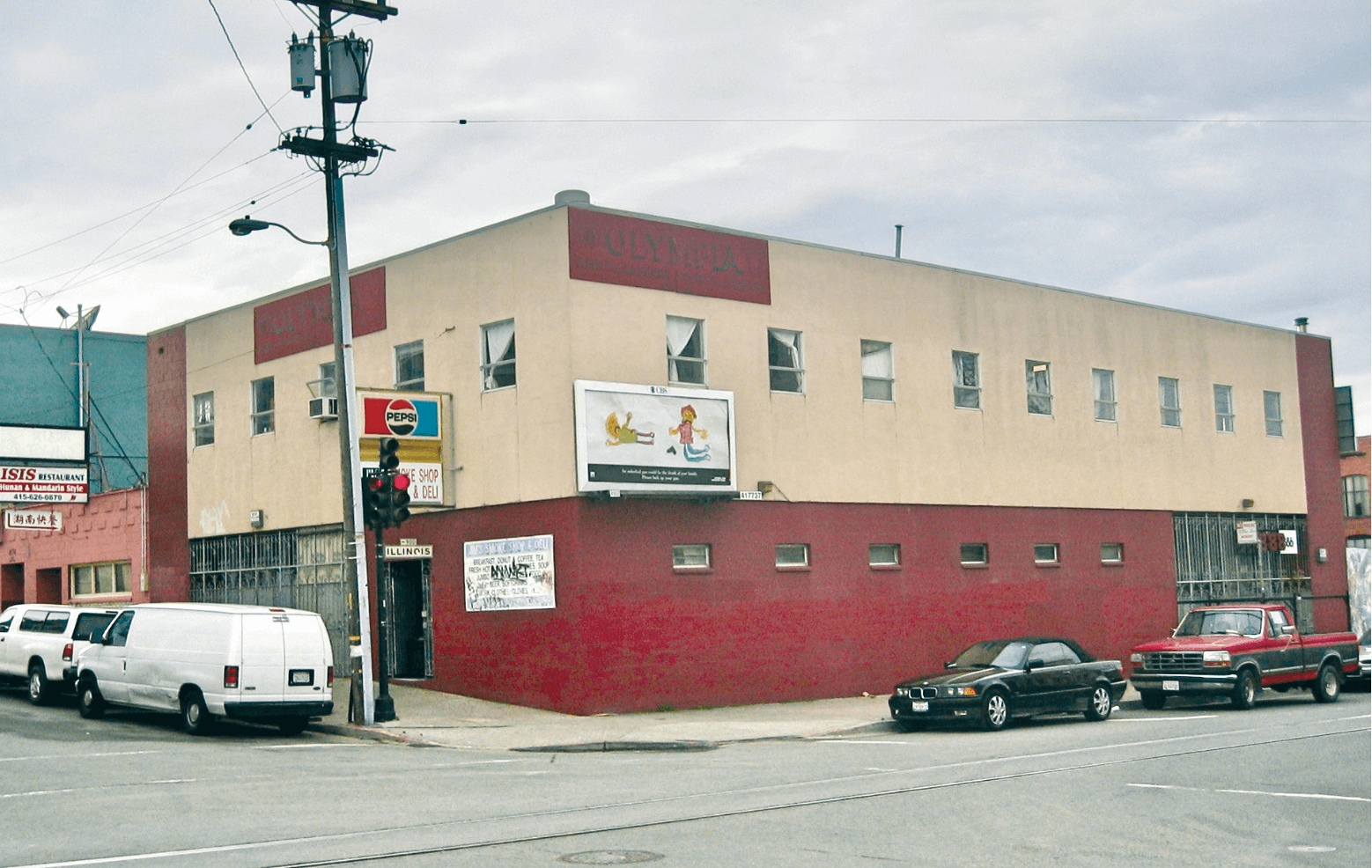
When National Basketball Association superstar, Steph Curry, recently closed an $8.5 million deal to acquire a non-descript office-warehouse in Dogpatch it drew national attention, highlighting a red-hot real estate market in the increasingly popular historic waterfront neighborhood.
The high-profile transaction also marked the beginning of the end for the Olympia Building, one of the last remaining small-scale, mixed-use structures along a stretch of bayfront where dozens of such utilitarian spaces once stood. The two-story cinderblock and concrete edifice has ties to the area’s historic past, and in the 1990s was home to pivotal grassroots community activism that helped put Dogpatch on the map.
I’m in a unique position to tell the back story of the building that Steph bought. For 30 years, from 1992 to 2022, I held its master lease and lived and worked there.
Located at the corner of 20th and Illinois streets, the Olympia is roughly 10,000 square feet, including a ground floor loading dock. It’s a short walk to Chase Center, home of the Golden State Warriors, the franchise Curry has led as a dominant point guard since his 2009 rookie season.
Plans are to raze it to make way for a sleek five-story structure, which will rise to 68 feet, totaling roughly 25,000 square feet. The site has already been approved for redevelopment, although additional approvals are needed to begin the project. The proposed new building, designed by Oakland-based Workshop 1, will reportedly house Thirty Ink, Curry’s business-philanthropy-and-media collective, as well as an “arts activities” space, and a three-bedroom penthouse with terrace, rooftop deck and stunning waterfront views.
The Illinois Street property is a sacred site for many of my own personal and professional milestones. My long-term lease reflects a bygone era, when enterprising artists and entrepreneurs could find affordable industrial space in once edgier parts of San Francisco, for adaptive reuses that contributed to the City’s vitality and economic success.

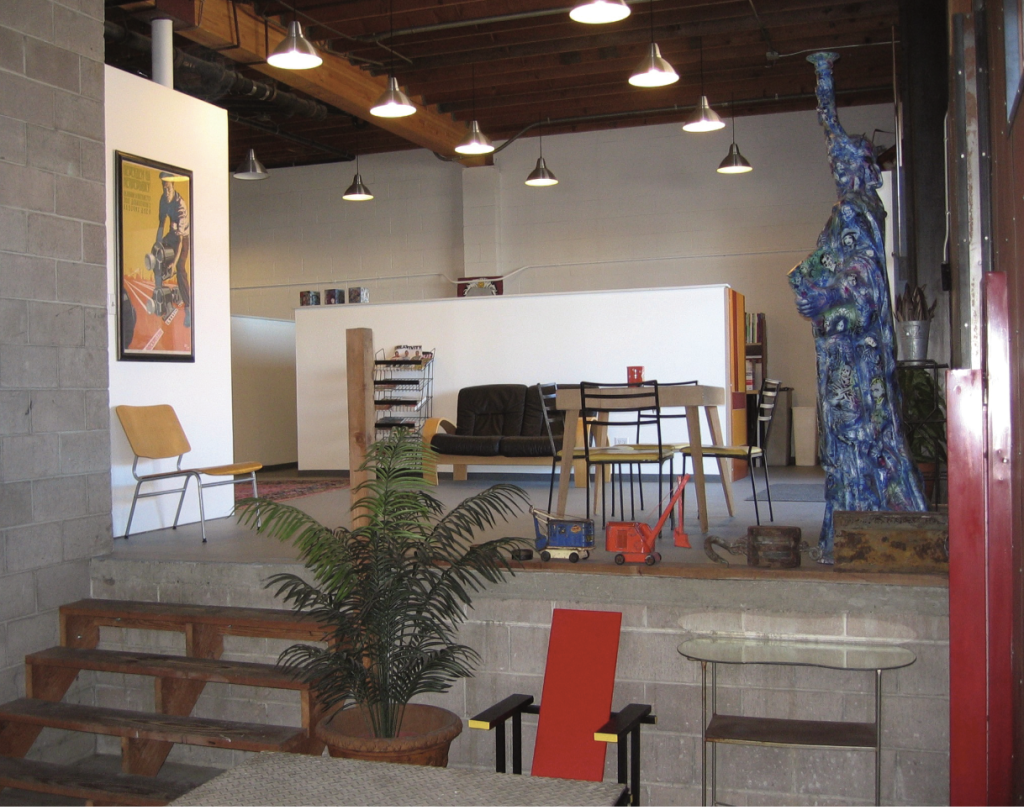
During my lengthy tenure in the building, I hosted legendary warehouse parties, launched multiple businesses, supported local artists, got married, established a family, and sub-leased space to startups, nonprofits, and commercial enterprises. The spacious interior was used as a hub for political activism, community meetings, neighborhood planning, and advancing local historic preservation efforts.
Dogpatch was, essentially, a no-name neighborhood when I first moved there in 1992. It’s generally bounded by Mariposa Street to the north, 23rd Street to the south, Highway 280 to the west, and Illinois Street to the east. Folks referred to it as “Potrero Hill” or the “Central Waterfront”, which were too broad and inaccurate.
By the mid-1990s, when a tsunami of unchecked demolitions and development began to threaten the community’s soul, a group of activist-residents launched an effort to safeguard the neighborhood’s unique identity. A sharp young preservation architect, Christopher VerPlanck, was central to the effort. VerPlanck had studied the area extensively, documented its ties to labor history, and believed it could be designated a historic district.
The name “Dogpatch” was ultimately adopted, an established but rarely used local moniker that matched the district’s gritty personality. Interviews with old-timers revealed that Dogpatch was originally a derogatory 1940s-era slang term used by residents and, reportedly, the local police force. It referred to the area’s “back woods” status in an otherwise sophisticated city. The name originally derived either from stray dogs attracted to the meat-packing plants once located nearby or was inspired by Li’l Abner’s hillbilly hometown in the popular syndicated comic strip, which debuted in 1934.
Three 8 Creative Group, the design communications studio I ran on Olympia’s ground floor, took on Dogpatch branding as a pro bono project. We created numerous graphic treatments, designed the original Dogpatch Neighborhood Association (DNA) logo, printed outreach materials, press packets, and multi-media presentations. We also crafted Dogpatch-themed T-shirts, hats, and posters. The materials were used to pitch the new identity to politicians, policy makers, the press and public. Within a few years the neighborhood went from being unknown to being prominently profiled in The New York Times.
In 1998, I was among a handful of DNA founders and served as its first president. Initial planning and executive meetings took place in the Olympia Building, before moving elsewhere.
It was in the Olympia that the Potrero Central Waterfront Committee met to plan neighborhood meetings and compiled the Community Land Use Planning Recommendations Report. The influential 60-page analysis covered development, traffic and infrastructure, housing, historic preservation, port and maritime uses, jobs and industry, open spaces and public places, and environmental impacts. Published in 1999, the document prompted municipal planners to rethink eastern neighborhood zoning laws. In 2008, the City enacted new guidelines to preserve arts and industrial uses, protect historic resources, and encourage mixed-use residential and commercial development.
The original concept and renderings for what’s now Crane Cove Park, on Illinois Street at 18th, and initial community-based plans for Pier 70 rehabilitation and adaptive reuse, were drawn up in the Olympia Building. These ideas were later finessed by the Port of San Francisco’s Central Waterfront Community Advisory Committee.
At the Olympia volunteers compiled vintage photos and written documentation to tell Dogpatch’s compelling history. Our Dogpatch “dog and pony show” educated stakeholders and helped planners, policy makers and preservationists, led by VerPlanck, successfully secure historic district status for Dogpatch, in 2002.
Other notable community activism that took place in the Olympia Building included work to close the polluting Hunters Point and Potrero power plants, improve public safety, save Esprit Park as a public space, and develop local public amenities.
By 2010, growing family and work obligations forced me to minimize my community involvement. I’m grateful that others continue this work.
The current Olympia structure is only 52 years old. However, its legacy extends more than a century, to the waterfront’s glory days, when the Pier 70 shipyards and industrial operations along Potrero Point thrived as the region’s most important center for heavy industry.
In 1916, John and Barbara Syme, married immigrants from Scotland and Ireland, respectively, opened a three-story boarding house on the site to serve waterfront workers. It was named after the U.S.S. Olympia, flagship of Commodore George Dewey’s naval fleet at the Battle of Manila Bay, during the Spanish American War of 1898. Built at the Union Iron Works Shipyard across the street, it was the most advanced and famous vessel of its time, positioning America’s Navy as a world power.
The original wood-clad Olympia Building was a gathering spot for laborers during World War 1 and the Second World War, when the local yard built dozens of submarines, more than 100 warships and destroyers, and repaired or converted more than 2,500 vessels. There was a restaurant and saloon on the ground floor and worker’s housing above. In those days, waterfront industries attracted scores of immigrants and migrant American workers – from Irish, Scottish, English, Italian, Scandinavian, and Mexican descent – who shaped San Francisco’s demographics. Migrant Americans included impoverished Dust Bowl refugees, and African Americans leaving behind harsh segregationist policies in rural Southern states.
The years following the Second World War saw a marked decline of the City’s waterfront industries. After a fire gutted the upper floor of the Olympia, and increasing maintenance issues plagued the original structure, the Syme family demolished it in 1971. They built the current structure in 1972.
My original lease was a handshake deal with Bill Syme, a true old-school San Franciscan, one of three sons of the building’s founders. It was renegotiated and extended over the years with no need to involve brokers or lawyers. I went on to maintain a good relationship with Ronaldo J. Cianciarulo, who acquired the building in 2016.
The Olympia Building changed my life. It opened doors, allowed me to establish businesses, collaborate with talented people, and help create legacy for Dogpatch, when it was most needed. Today, I live happily on a small farmstead in rural coastal Marin County.
Of all the high-wealth individuals that could have bought the property, I fully approve of Steph Curry. Glad to have his vision and positive energy recreate the site. May the spirit of community remain there forever.
Top: the Olympia Building, in Dogpatch, circa 2001. The unassuming structure was recently acquired for redevelopment by basketball superstar, Steph Curry. Photo courtesy of John Borg
 Steven J. Moss
  Jessica Zimmer
  Mark Steensland