
With winter’s arrival, even in San Francisco’s mildly cool weather many plants turn dormant or die. But some species survive and a few even begin life near the end of the year.
One such plant is miner’s lettuce, which is found throughout the City, including in Potrero Hill’s parks, vacant lots and back yards.
Miner’s lettuce, Claytonia perfoliate – also known as winter purslane, spring beauty and Indian lettuce – is native to western North America, with a range that spans from southeast Alaska to Central America. The stems, flowers and leaves are edible. It got its name during the California Gold Rush when 49ers ate it during winter to ward off starvation. With its high amounts of Vitamin A, C, and iron, it helped them avoid scurvy and stay healthy.
Miner’s lettuce is shade tolerant and grows well with other plants. It’s an annual; each specimen lives only for one season. It grows from November to June, then leaves its seeds to lay dormant in the soil until late autumn. In some years a crop of miner’s lettuce may survive throughout summer and fall into the next winter.
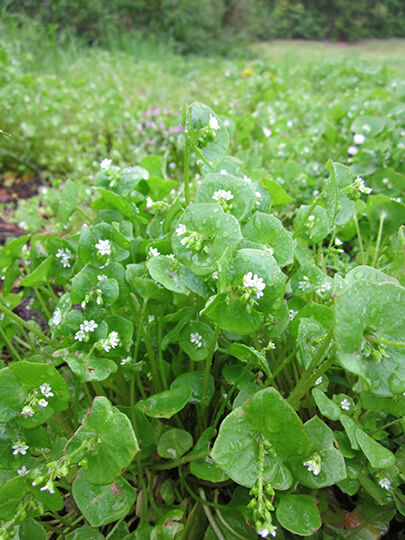
Miner’s lettuce is distinguished by circle-shaped green leaves with tiny white flowers. The plant starts as a thin stem looking much like a blade of grass. It forms a leaf a few inches above ground that grows to encircle the stem. The stem then rises above the circular leaf to produce a miniature white flower. Each plant grows about 12 to 30 stems with flowers. On rare occasions, instead of producing the flower a stem will grow another circular leaf a few inches above the lower one, then the flower rises above the upper leaf.
All the stems branch off from the root either at or just above ground level. The plant is delicate, yet even when its stems protrude above ground level, it maintains its balance and produces stems and flowers. The root is more wiry than woody and holds onto the soil in what might be called a life grip with the strength of a death grip. It can grow in such a tiny bit of soil that it’s almost an air plant (epiphyte).
When a plant reaches about six months old, roughly 86 in miner’s lettuce years, it starts to die. Its leaves fade and turn dead grass yellow. The leaves of a few specimens become purple. The little white flowers on some dying plants change to baby blue.
Explorers and botanists have successfully transplanted miner’s lettuce to Ohio, Georgia and other eastern states and overseas to Cuba, England and Australia, where the species can grow wild or cultivated. Unlike many other invasive species, miner’s lettuce is rarely a pest and develops well with other plants just as it does in its native areas.
Reprinted from Cognition, 2021.
 Thomas Hunter II
  Jessica Zimmer
  Lucie Tran and Finn Banbury