
Prior to 2016, property owners shouldered most of the responsibility for caring for San Francisco’s 125,000 street trees; plants growing in “basins” cut-out from the sidewalk. That changed with passage of Proposition E, an initiative approved by 79 percent of voters which allocates a minimum of $20 million a year from the City’s general fund to maintain the “urban forest” and fix tree-related sidewalk damage. Expenditures were budgeted at $23 million for fiscal year 2025-26.
StreetTreeSF is operated by the San Francisco Public Works Bureau of Urban Forestry. Since July 1, 2017, its arborists, landscape gardeners, and cement masons have cared for 80 percent of the City’s street trees.
According to Christopher Heredia, Bureau of Urban Forestry public information officer, San Francisco has one of the smallest tree canopies among large cities in the U.S., largely because trees were scarce prior to European settlement. Most of what’s now San Francisco was historical covered by sand dunes and grasses. Tree cultivation began in the 1800s; by 1879, 155,000 trees had been planted.
“We are at 13.7 percent, lower than the national average of 21 percent, said Heredia.
Other municipalities in California want to foster their urban forests. The City Council in Sacramento – the “City of Trees,” with almost 24 percent tree canopy – recently introduced a measure to plant 25,000 trees annually over the next 20 years to mitigate increasing heat due to climate change and to help the jurisdiction become carbon neutral by 2045, with trees absorbing as much carbon dioxide as is being humanly produced.
In San Francisco, the Bureau of Urban Forestry delegates much of its planting to Friends of the Urban Forest. The agency and nonprofit collaborate on decisions about what species to cultivate partly based on the microclimates of individual neighborhoods.
“For instance, Bayview-Hunters Point tends to be hotter,” Heredia explained. “So, we plant trees that do better in that climate versus the Sunset or Outer Richmond where you’re going to have more fog and need trees that are resistant to the kind of fungus that is prominent in moist environments.”
Because the science and politics of tree selection is ever-changing, decisions are refined through an on-going process involving a matrix of numerous concerns, such as shade, health benefits, and ability to capture particulates from pollution.
Street trees, particularly their expanding root systems, are a significant cause of sidewalk damage. Modular suspended pavement systems allow roots to grow freely without causing footpath uplift. However, this method isn’t commonly used in San Francisco. As a result, there’s an ongoing relationship between planting street trees and ultimately the need to repair the damage they cause.
For those who don’t want the City to maintain trees adjacent to their property, StreetTreeSF allows residents to apply for an exemption. Approval is only granted when a certified arborist is hired to prune. Cutting a tree without securing such an exemption can result in a $10,000 fine, even if the tree was damaged during a storm.
“In those situations,” Heredia said, “residents should call 311 or use the 311 app to report it.”
Pacific Gas and Electric Company also prunes trees to maintain an 18-inch clearance from high voltage power lines.
Heredia said highest priority is placed on repairing sidewalks near facilities which serve vulnerable populations like seniors and the disabled, and places such as hospitals and schools.
Because Proposition E transferred responsibility for the trees to the City, it’s accountable for any damage caused by those trees.
“The good news,” said Heredia, “is that you’re no longer liable for that falling limb or that crack in the sidewalk. If a tree falls on a car and totals it, that’s the responsibility of the City of San Francisco. The only exception is if the damage occurred prior to 2017, then that is still the responsibility of the adjacent property owner.”
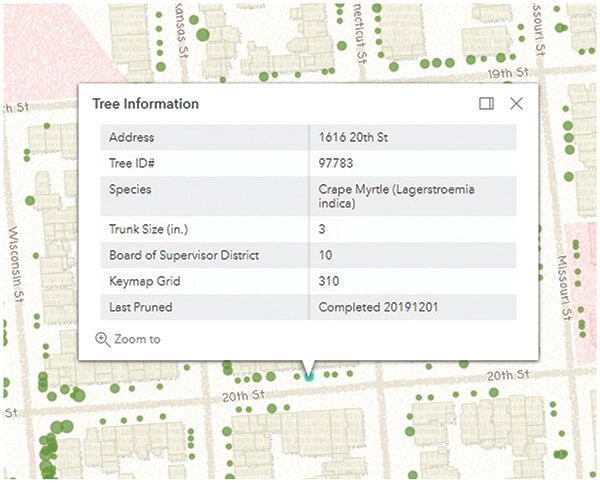
Residents can find out when maintenance on street trees in their neighborhood was last performed, or when it’ll be performed, by using the map available at https://bsm.sfdpw.org/urbanforestry/.
Image, top: information for one of the trees in front of San Francisco Public Library’s Potrero Hill branch. Source: https://bsm.sfdpw.org/urbanforestry/
 Rohit Prasanna
  S Anne Steinberg