
Seven of the most prominent candidates for governor showed up for a debate last month at the Bayview Opera House, hosted by the Black Action Alliance, aired live by KTVU FOX 2. The venue was packed with well-dressed African Americans, some of the men wearing hats that’d be fashionable when Eisenhower was President. The mostly decorous atmosphere – enveloped within the elegant 1888 building – was matched by the respectful interactions between the contenders, all of whom save one – Steve Hilton – were running as Democrats.
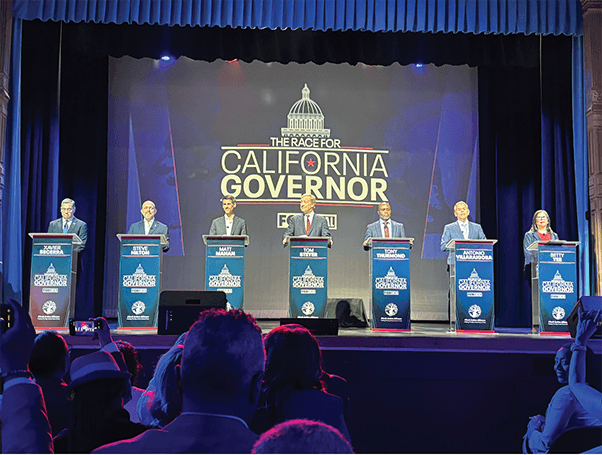
Still, with the doors tightly shut and no windows, both the discussion and the interior atmosphere became increasingly stuffy.
As Hilton pointed out, a Democrat has served as California governor for more than 15 years, during at least a dozen of which the party has had a legislative supermajority. Although one Democrat is different than another – Daniel Lurie appears to be more effective than London Breed; Jerry Brown is a distinct political animal from Gavin Newsom – returning that party to power would seem akin to coloring within the lines; if you’re happy and you know it (generally) stay the course. This notion was reinforced during the debate, when most heads nodded in agreement whether it was former Health and Human Services Secretary Xavier Becerra, former Los Angeles mayor and Assembly Speaker Antonio Villaraigosa, or any other Democratic candidate who spoke.
Still, a sea change was detectable. Terrified of rising gasoline prices, virtually every candidate, bar billionaire investor and climate activist Tom Steyer, indicated that they’d work towards a more “balanced” energy future, likely meaning a retreat from aggressive efforts to phase out fossil fuel cars, and milder treatment of oil companies. Steyer is notable for his call to break up the state’s investor-owned utility monopolies, one of the rare fundamental reforms floated in the race so far.
All the candidates wanted to reduce government barriers to building housing. State Superintendent of Public Instruction Tony Thurmond called for construction of two million new homes by 2030. This is an impossible task, given financing and workforce constraints. No more than a quarter-million homes have ever been built a year in the state’s history. Which prompts the question, is it a good thing to be unrealistically ambitious, in service of energizing progress towards a goal, or does it set a politician up to be a liar.
The candidates expressed deep sympathy for “working” Californians, who might be a paycheck away from being dislodged from their homes or unable to regularly put food on the table. Yet none appears to support a universal basic income or increasing the minimum wage, $16.90 an hour, to a livable one, which is almost twice that much. They all want a deep expansion in mental health services, without connecting that to a concomitant requirement to vastly expand the pipeline of well-educated mental health professionals housed in proper facilities being paid livable wages.
Former Orange County Congresswoman Katie Porter, Congressman Eric Swalwell, and pro-Trump Riverside County Sheriff Chad Bianco didn’t attend the debate, which no doubt reduced its entertainment value. Bianco was atmospherically invited into the room by Hilton, who criticized him for capitulating by taking a knee in response to violent “BLM riots,” prompting a gasp from the mostly Black audience. Which fulfilled his goal of seeming to be cleverly controversial.
Who to vote for may come down to personality and expectations about the future. If a voter’s greatest worry is a meltdown of democracy, including a permanent President Trump, Becerra, who proved himself a scrappy litigator when he was Attorney General, might be the best choice, especially since none of the candidates have a military background, which could otherwise come in handy. For a voter looking to take on fossil fuel companies and monopoly utilities, it’s Steyer. Those more optimistic about the future might lean towards Matt Mahan, the mayor of San Jose, who exudes a charming can-do attitude that points to a promising future, both for himself and his constituents.
 Jessica Zimmer
  Mark Steensland