
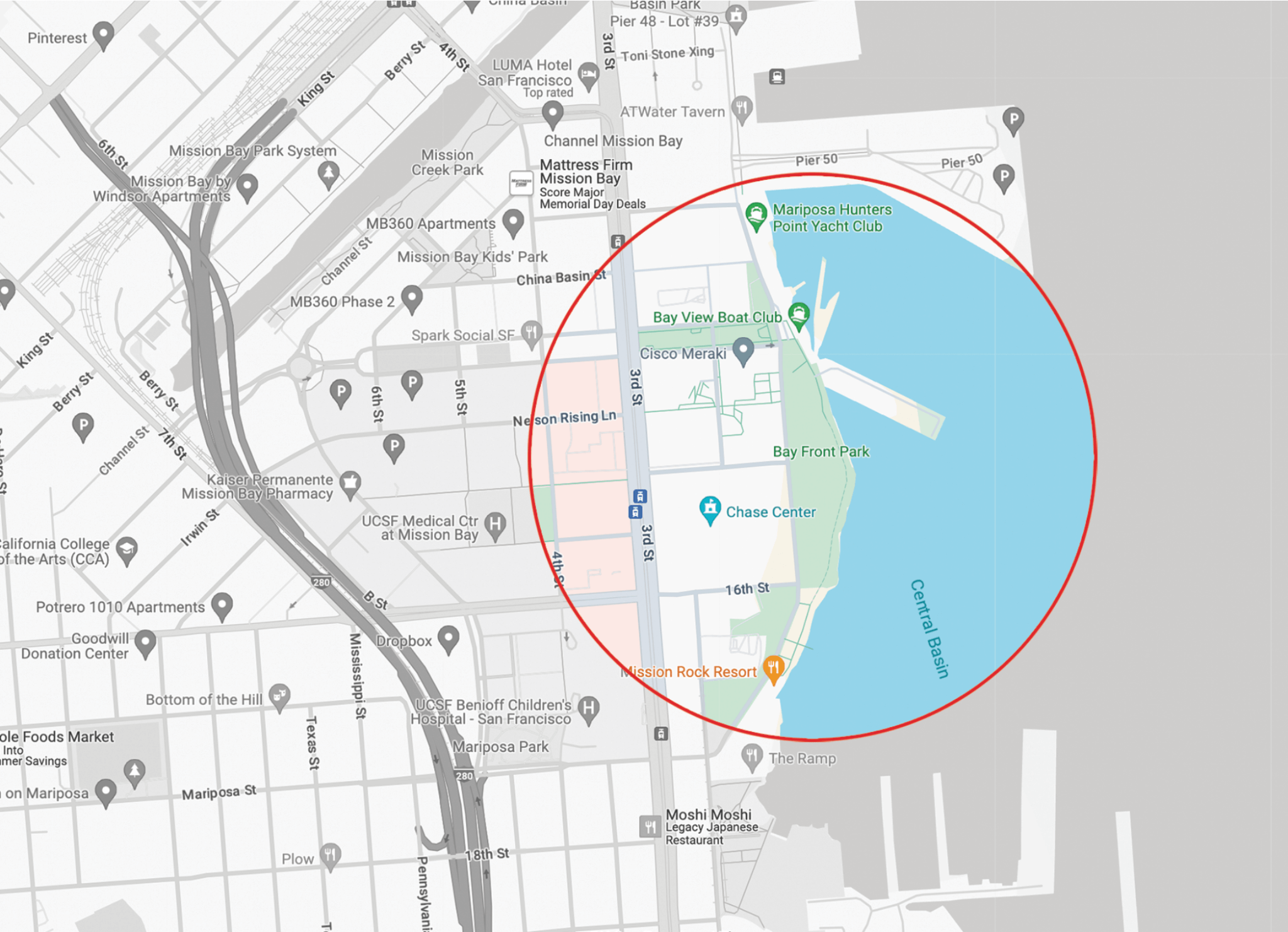
Bayfront Park, 5.4-acres located between the Chase Arena and the Bay, is likely to open by the end of the year. Construction was delayed by the need to remove contaminated soil a crew discovered while auguring a hole to install a light pole. The City didn’t disclose the nature of the pollutants. Since it was located deep in the ground it may have been present for a while.
Completion of the space is contingent on Public Works inspection of work done by the developer, Mission Bay Development Group (MBDG), as well as formal acceptance of the new park by the San Francisco Board of Supervisors (BoS).
Public Works is tasked with ensuring that workmanship is completed correctly, fixtures like benches are built and installed properly, and grass and flowers are taking hold.
“We were trying to get the concrete poured before the rainy season started in the winter. That’s when we ran into an environmental issue. There was a spot on the southern end of the park where contaminated soil was discovered and needed to be removed. Then we had to wait for tests to indicate there was no more contamination. We resumed construction, but then the rain started,” said Marc Slutzkin, deputy Office of Community Investment and Infrastructure (OCII) executive director.
Rain had saturated the ground, making it difficult to install utilities and pour concrete.
“It’s not feasible to tent a space just over five acres. Water flows everywhere, including off tarps or tents on the ground below. Also, the groundwater rises close to the Bay when it rains. There were times when we had brief periods of sunshine. Short periods like two days of full sunshine aren’t enough to dry out soil to pour concrete,” said Slutzkin.
When Bayfront Park opens, the Port of San Francisco will assume responsibility for its maintenance, operations, and activation, according to Eric Young, Port of San Francisco director of communications. The Port is accountable for other commons along Terry Francois Boulevard in Mission Bay, including Bayfront Park North and the Corinne Woods Boat Launch.
Bayfront Park was conceived as part of the Mission Bay South Redevelopment Plan, which the BoS approved in 1998. It’s designed to integrate with and increase access to nearby open spaces, including Agua Vista Park and Mariposa Bayfront Park to the south and southwest.
Lotus Water Engineering, a San Francisco civil engineering firm, is providing support services, including reviewing contractor materials and product data to ensure it meets specifications and participating in site meetings.
“Our site visits to date have been focused on the construction of the bioretention basins, site drainage systems. and overall site grading. When unexpected conditions arise during construction, we also collaborate with the design and construction teams to recommend design modifications to help address the issue,” said Shauna Dunton, principal civil engineer for Lotus Water Engineering.
Lotus worked with landscape architect, SurfaceDesign, Inc., a San Francisco-based firm, to integrate passive stormwater management systems into project. The company designed the system so stormwater runoff will be conveyed through shallow swales and trench drains, traveling through several bioretention basins for treatment to the extent topography allows. Bioretention facilities naturally remove pollutants from runoff as it filters through plants and engineered soil. The system allows visitors to see how runoff moves from paved surfaces to natural treatment before it’s directed to the San Francisco Public Utilities Commission storm drain system and, ultimately, the Bay. Lotus also helped determine how the site will handle sea level rise and storm surges and led design of grading, drainage, and demolition plans.
Mission Bay residents are frustrated that it’s taking so long for the park to open, especially in comparison to other nearby commons, like China Basin Park between South-of-Market and Mission Bay. This five-acre park is a part of The San Francisco Giants’ Mission Rock project, a mixed-used community south of Oracle Park.
According to Ralph Anavy, a Mission Bay resident, Bayfront Park was supposed to be completed long ago, in tandem with the Chase Arena.
“Instead, they blocked access to the Bay for years with nothing going on. I drive by the site on a regular basis. They’ve had a skeleton crew out there for months, with no activity,” said Anavy.
Mission Bay resident Adelaide Hulbert said weather-related construction delays are understandable.
“Still, there’s a sense among residents that the building of Bayfront Park is going very slowly, especially in contrast to The Giants’ new China Basin Park, which was built and opened much more quickly,” said Hulbert. “It would help if OCII communicated the park’s status more broadly within the community.”
Bettina Cohen, a Mission Bay resident, and frequent user of the neighborhood’s parks said a great deal of public infrastructure has suffered from extended delays over the years.
“Nothing new there. It’ll be a great park once it’s open because look at what a great park P3 has turned out to be,” said Cohen.
“P3” refers to the Mission Creek Park extension between Third and Fourth streets fronting over the water.
Cohen added that Bayfront Park will serve additional people moving into the neighborhood. A new residential building at 400 China Basin and several residential buildings at Mission Rock will soon open.
“Our existing open spaces are already full to capacity sometimes with families, seniors, and dog owners enjoying the parks. We’re a densely populated corner of the City. I’m definitely seeing the parks increasingly more crowded as word gets out that Mission Bay’s parks are the jewel of the City’s parks system,” said Cohen.
Bayfront Park. Image: Courtesy of Google Maps
 Thomas Hunter II
  Tamala Motta