
Reported wrongdoing has steadily declined in San Francisco, with 2024 experiencing the lowest rates in two decades. So far, the downward trend has continued in 2025. In the first half of this year, violent crime – homicide, rape, robbery, assault, and human trafficking – decreased by 19 percent, with property crime – burglary, motor vehicle theft, arson, and larceny theft – down 25 percent citywide.
Potrero Hill and Dogpatch are served by the San Francisco Police Department’s (SFPD) Bayview Station, which covers one of the largest areas in the City, including India Basin, Candlestick, Portola, Bayview, and Hunters Point. Showplace Square and Mission Bay fall under the Southern Station, also responsible for South-of-Market, Rincon Hill, Yerba Buena Island, and Treasure Island.
According to Bayview Station’s crime dashboard, as of September 2025, there’s been a roughly 30 percent decrease in property and violent crime. Motor vehicle theft dropped by 46 percent, burglary was down 36 percent, rape by 30 percent. The number of homicides rose by one-third, with arson incidences up 26 percent. There were 14 reported rapes and four murders.
The Southern Station experienced a 38 percent rise in property-related incidences, largely due to an 88 percent jump in larceny theft; stealing bicycles, motor vehicle parts and accessories, shoplifting, and pickpocketing. There was a 38 percent decrease in motor vehicle theft, 12 percent decline in burglary, and nearly 19 percent drop in arson. Reports of violent crime fell by nine percent, with no homicides this year, a 16 percent reduction in rape, and a nearly 10 percent cut in assaults.
There’s been decades-long efforts to revitalize Dogpatch and Mission Bay, with warehouses and industrial work giving way to high rises, tech company headquarters, and restaurants. The neighborhoods have attracted a new demographic and spirited economic activity.
Mission Bay was transformed from marshland to landfill in the mid-1800s, emerging as a Southern Pacific Railroad Company railyard and a center for shipbuilding, meat production, and canneries. A steep decline in maritime activity left only the railroad, whose land was ultimately parceled off to developers. In 1998 the Mission Bay Development Agency, a public-private partnership with the San Francisco Redevelopment Agency, launched a $9 billion revitalization project, the largest urban development initiative initiated by San Francisco since construction of Golden Gate Park in the late-1800s. The plan was initially anchored by the 14.5-acre University of California, San Francisco Mission Bay campus. A Kaiser Permanente facility followed, along with the corporate headquarters of Uber and Lyft, as well as Chase Center.
The area now has more than 6,400 residential units, roughly 30 percent designated to be below market rate or affordable housing, residences that cost no more than 30 percent of a household’s monthly income. The boom in residential and commercial activity resulted in a 200 percent population increase between 2010 and 2020.
To date in 2025, 674 crimes have been reported; 385 – 57 percent – remain under investigation. One hundred and seventy-one were property crimes, 26 of which involved unlawful or forced entry into a residence or other building. Fifty-one were violent crimes.
In 2024, there were 1,547 crimes reported, 987 – 63 percent – remain open. Three hundred and sixty-two were property crimes, 42 of which included unlawful or forced entry. One hundred and thirty-six involved violence.
Last year there were two shooting occurrences near Chase Center and China Basin eight days apart. According to Southern Station Captain Luke Martin the gunfire was “unrelated and isolated incidents not typical of the Mission Bay neighborhood.”
Originally a warehouse district serving the Port of San Francisco, economic activity in Showplace Square slowed in the 1970s as the maritime industry declined. The area ultimately emerged as a design hub, its historic warehouses renovated into furniture showrooms. Though zoned as a production, distribution, and repair in the 1980s, adjustments were made to accommodate growing demand for residential buildings in 2008. With construction of several apartment complexes, the area’s population has increased by 38 percent over the past 25 years. Property crime at residential and other buildings are the top reported wrongdoings, particularly burglary, larceny, and motor vehicles theft.
Potrero Hill emerged as a working-class neighborhood soon after the Gold Rush in the 1850s. It remained largely blue-collar until the 1990s, when it began drawing tech professionals, transforming the Hill’s demographics. Approximately 450 crimes have been reported in the neighborhood to date in 2025, with 273 – 60 percent – still unsolved. One hundred and twenty-two property crimes have been reported, 27 as unlawful or forced entry into a residence or other building; 32 have been violent crimes.
In 2024, there were 734 reported wrongdoings, 604 – 82 percent – of which remain active. Two hundred and eighty-nine were property crimes, 121 unlawful or forced entry; 69 violent crimes.
Still, the decline in reported crimes hasn’t made some residents feel safer.
“I’ve lived in Potrero for years, and I can’t imagine leaving. My kids are worried about what they hear,” Carin said, “I have the Ring camera now and always double check that my car is locked, but there’s only so much you can do. Isn’t that what the police are for?”
Originally an industrial area and home to working-class families, new residential construction and accompanying amenities in Dogpatch has steadily attracted young professionals. In 2002, it was designated an historic district. The neighborhood experienced a 226 percent population increase between 2010 and 2020; the citywide average was just under nine percent during the same period.
“People used to be confused when I said I lived here,” a former resident said, “Now they ask me how I could ever have moved away.”
The neighborhood boasts art galleries, ample food and drink options, with new development emerging at former shipyard and power plants sites. With a $5 million investment from the University of California, San Francisco – which doesn’t pay property taxes – a renovated Esprit Park re-opened earlier this year.
Ninety-six crimes have been reported in the neighborhood to date this year, 83 – 86 percent – of which remain open. Thirty-eight were property crimes, with 11 identified as unlawful or forced entry. Eight were violent crimes.
In 2024, 284 crimes were reported, of which 252 – 88 percent – are still being investigated. One hundred and thirty-four were property crimes, with 46 unlawful or forced entry; 25 were violent crimes.
Residential package theft has long been a complaint across the neighborhoods. Break-ins – attempted or successful – and vandalism aren’t uncommon at retail and residential spaces, according to SFPD crime data. Residents of larger apartment buildings routinely report faulty or broken security points, including entryways, package rooms, and garages. Tailgating and verbal or physical assault outside buildings isn’t unusual.
“My entry fob didn’t work (again), so I had to go to another entrance,” said one resident involved in an incident, who declined to be named. “It was dimly lit, and someone leapt out at me…I kept trying to get into the building, but so did he. I reported it to management, which then sent out a notice asking residents to be more careful, but something like this seems to be a near monthly occurrence. Nothing was said to me about the fact that I was traumatized just because they can’t stay on top of security.”
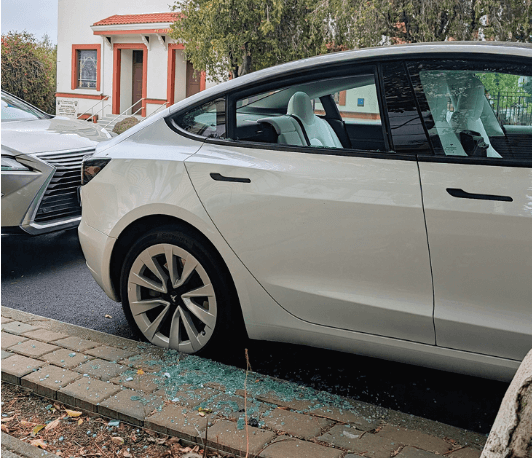
Residents have lively text threads and community boards about their experiences or to alert others about incidents. Taped car windows or “Nothing in here is worth it” signs on vehicles and residential doors are a common sight.
Most larger apartment buildings aren’t zoned for street parking permits, according to the San Francisco Municipal Transportation Agency (SFMTA). Meters are being steadily installed in Dogpatch and Mission Bay, along with new hourly parking restrictions. Garage parking typically begins at $300 per month, a price point that forces many to park on the street even as spaces become scarcer with population growth. Police reports are required for most insurance claims associated with vehicle break-ins, but SFPD generally acknowledges that little can be done to catch the perpetrators, even if the incident occurs near a surveillance camera.
Last year, SFPD launched Real Time Investigation Center (RTIC), which uses technology, including drones, Flock Automated License Plate Readers, public safety cameras, LiveView Technologies mobile security units and other tools simultaneously. According to an April press release, SFPD made more than 500 arrests with RTIC assistance. Still, less than half of reported crimes are solved within a year or two after they’ve been committed.
“Resources are tight everywhere, and we want to believe that our City is trying its best. Property is one thing…expensive to be sure, but there are other factors at play. We’re all fiercely proud of our neighborhoods here, but our quality of life shouldn’t carry a price tag,” Cara Lee noted.
 Steven J. Moss
  Tamala Motta
  S Anne Steinberg