

Aruna Lee launched Volcano Kimchi in 2014 after years of experimenting with vegan kimchi recipes, alongside other influences, including her Korean upbringing, PBS cooking shows, and YouTube videos.
“When I first moved here, I didn’t really know how to cook,” recounted Lee. “I learned cooking from watching Saturday morning cooking shows from people like Jacques Pépin, Martin Yan, and Lidia Bastianich. I would be inspired, buy the ingredients, and invite people over for a nice dinner every weekend. That’s when I started to learn to cook. In 2008, I started learning from Korean chefs online. I was more mimicking the traditional way to make kimchi when I started, but the way I grew up, we didn’t add many of those ingredients like shrimp paste, fish sauce, garlic, or onions. I slowly found more of my own way to the kimchi-making process.”
Lee was adopted by a Buddhist nun when she was six years old and grew up in a monastery eating wild foraged vegetables and kimchi.
“I really missed the food that I grew up eating after I moved here and had my son. I worked for a nonprofit for 10 years and got let go due to the 2008 financial crisis. I didn’t want to work for someone else again, and after a couple of years of experimenting with kimchi, I just thought ‘why not’. I took a batch of kimchi to Rainbow Grocery, and they loved it. A lot of people have a plan first and then do, but me I just jumped in and learned as I went,” said Lee. “When I started, I don’t think I had so much passion to make kimchi like ‘I have to be a kimchi maker’. The more I did it, the more I passion got, and now I love it, so it just gradually happened. It’s like fermentation.”
Volcano’s growth accelerated when it became a seasonal pop-up at the Ferry Building farmer’s market in 2016. As the business expanded, so did Lee’s creative ambitions.
“The farmer’s market is my inspiration,” Lee gleamed. “We grew most of the vegetables at the Buddhist monastery and used those seasonal ingredients to ferment and pickle our kimchi. The farmers market really reminded me of those temples that I lived in in Korea. When I started at the farmers market, I would stroll around and get new ingredients like rhubarb, strawberry, and dandelion and be inspired to make them into kimchi.”
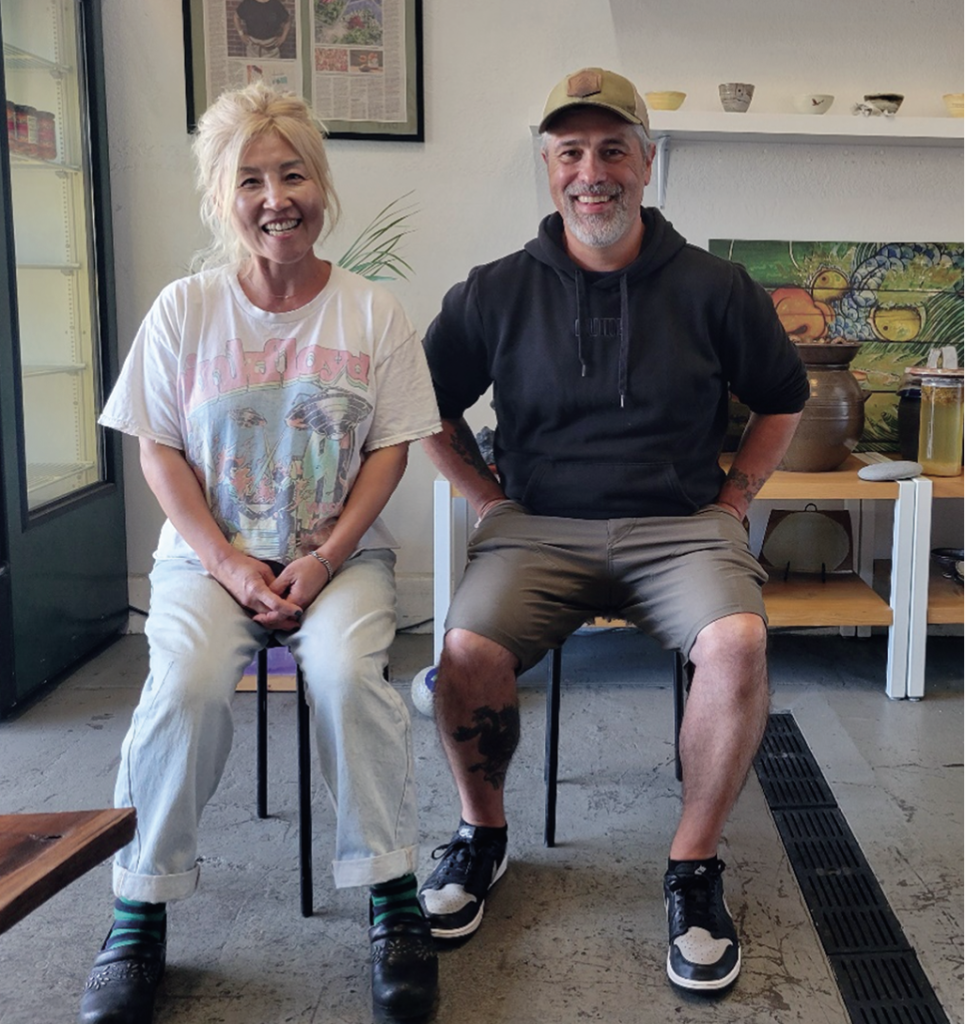
“It was right around the time the probiotic craze was around and the pickup was amazing, it was great to get this immediate encouragement from people,” said Peter Schurmann, Lee’s husband. “We also have great relationships with our customers, some of the same customers that came in 2016 are still coming every weekend. A woman who was suffering from an autoimmune disease that left her body in pain said that after she started eating our dandelion kimchi, she was able to minimize the medication she was on. She would call us to order a big batch of dandelion kimchi. The more Volcano Kimchi grew, the more people gravitated and resonated with it. There’s a remarkable community of people that we’ve met from kimchi.”
During the pandemic, Volcano moved to the third floor of the American Industrial Center. It briefly relocated, but ultimately settled on the building’s first floor, between Rocketbird and Bryr Studio. The Illinois Street space is homey and inviting, with a feel more like a living room than a shop, housing a kitchen where most of the kimchi is made and a sitting area in the front that’s used for grab-and-go and as a location for periodic events.
“We really wanted to create a community space, so people can talk and connect,” emphasized Lee.
Volcano Kimchi’s Gochujang is used to make the K-pop Loaf at Rise Up bakery, and the Gochujang Hummus and Toum at Obour Foods.
“We could scale up mass production for certain products,” said Lee, “but we have come to the decision that we would lose something in the process of making a lot of kimchi at once, so we decided to stay local.”
Volcano is located close to the 20th and Illinois streets property Stephen Curry recently bought to serve as the hub for Thirty Ink, the collective for his business entities.
“I’m waiting for Ayesha and Steph Curry to visit,” Lee quipped. “Ever since Curry bought the building nearby, I’ve been thinking that it would be fun to make Warriors Kimchi for our Warriors, depending on what they want. Pier 70 is also slowly opening, so we hope people will come by and check out our kimchi. We want to continue to do collaborations here.”
“I’ve been there since Day 1, just helping to do everything from loading the van to going to the market, to thinking out the labels and sell the product,” Schurmann said. “It has made me so much healthier, it has changed my palette. For me it’s completely changed my body. And as hard as it is running a small business, it has also brought us in touch with so many amazing, beautiful people. Someone new filters in almost every weekend.”
“I feel like maybe this is what I’m meant to do,” revealed Lee, “We have hired immigrant women, one from Thailand and one form Honduras, who are helping me at the kitchen. Now they can make kimchi without me and it’s just amazing. They bring their own flavors from their culture to create this Kimchi Culture. I really want to offer them more and help them, that’s my goal, so we can grow together. With them and others helping at the farmers markets, I just feel so fortunate and grateful to have people helping me. But running a small business is very challenging with lots of ups and downs. We’re still very small. I don’t know what my next chapter is, but until then I will do my best. One healthy gut at a time.”
 Mark Steensland
  Jessica Zimmer
  Thomas Hunter II