

These photographs surfaced from my sister’s, Elise’s, closet. Though the linage is uncertain, in 1918 my Jewish great-great grandparents, Israel Moskovitz and Elka Aspis, lived in Kelse, Poland with their children, Ruth, Golda, Gimpel, Esther, and Estelle. That year a riot – a pogrom – erupted in Kelse in which four Jews were killed and a large number wounded. It was part of a spasm of sporadic violence in Poland and throughout Eastern Europe that laid the groundwork for the Holocaust a few decades later.
The stressful and dangerous environment in which my forebears lived may account for the hollow ghostly eyes of everyone in the image, except for the two younger sisters, who retain a youthful glow, their souls perhaps not yet touched by their difficult realities. Israel looks like he’s carrying everything he owns under his great coat, ready to heavily flee when inevitably forced to do so.
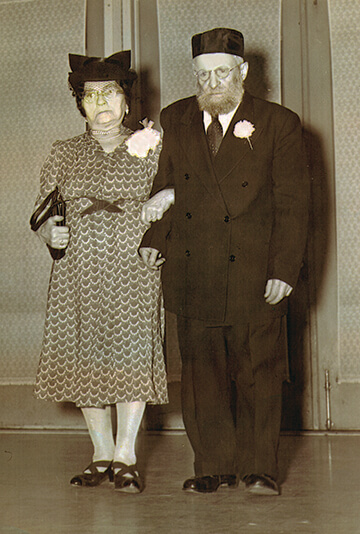
Years later, Israel and Elka are photographed at what may have been a wedding, given the flowers stuffed in their lapels. Their faces and bodies suggest a hard-lived life, full of disappointments and tragedies barely escaped, or perhaps not fully escaped at all.
Jews were not alone in being discriminated against. In 1877 a three-day pogrom was waged against Chinese immigrants in San Francisco by the City’s majority white population. The ethnic violence that swept Chinatown resulted in four deaths and destruction of thousands of dollars of Chinese immigrant property.
During the mid-20th Century, the practice of “redlining” was prevalent, in which banks would deny loans to African- and Asian-Americans. Non-white populations were financially segregated to the Western Addition, Bayview-Hunters Point, and Chinatown.
On September 14, 1961, San Francisco police officers raided Tay-Bush Inn, a gay nightclub, arresting 103 people, citing them as “visitors to a disorderly house.” Harassment of the gay community continued through much of the decade.
As far as Israel and Elka, hopefully their lives, constrained by poverty and prejudice, were touched by the pleasures of family and religious belonging. Their names to me are a blessing.
Tell us what’s in your closest:
editor@potreroview.net.