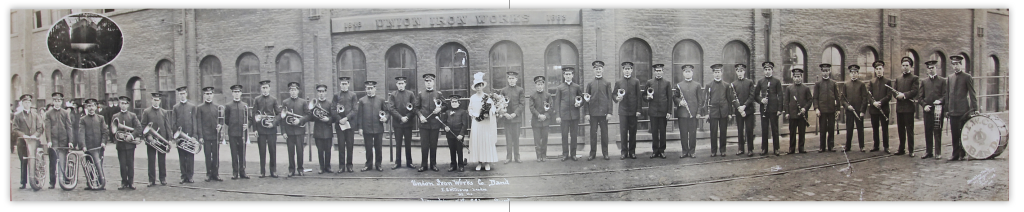
‘Yard-long’ group panoramic photographs become popular in the early-1900s. The images were often taken with a Kodak Cirkut camera, which rotated on a tripod, making every face recognizable. The horizontal rotation was so slow that one rising student appears twice in this writer’s high school graduation photo; he ran from one end of the group to the other as the camera lens turned. Though their heyday has passed, in their time yard-longs sold well; everyone in the photo wanted a copy. They’re a reminder that belonging to neighborhood groups was once central to people’s lives.
Next to California Canneries’ huge wooden building on Minnesota and 18th streets, a site now occupied by University of California, San Francisco residences. The opening of the Panama Canal in 1914 made European markets accessible. Northern California emerged as a central node of the state’s fruit canning industry. Melba Bowman canned peaches at California Canneries and was amused that after work other streetcar riders thought she was drunk, mistaking the scent of peaches on her clothing for alcohol. California Canneries went bankrupt in 1932, becoming Calbear Canneries until 1937, the year owner Moritz Feibusch died on the German passenger airship Hindenberg when it exploded into flames.
The American Can Company, launched in 1902 with consolidation of 60 tin concerns, was the world’s largest can producer in the early-1930s. It’s brick building on Third Street, built in 1915 and covering a city block, is now the American Industrial Center, owned by the Markoulis family for 50 years and home to more than 250 small businesses. In this 1921 yard-long, hundreds of Can Company employees are assembled. An arrow points to George Egan, who married Mayme Ayoob and lived in one of Dogpatch’s oldest buildings at 18th and Tennessee streets above the Ayoob’s market. Their son Tommy became a professional boxer, as profiled in the March 2025 View article, “Tommy Egan.”Lick Wilmerding Lux Day at the Panama Pacific International Exhibition in the Marina District, October 8, 1915, brought together alumni and students from two privately endowed schools with tuition-free curriculums combining academics and industrial arts. Lick Wilmerding’s goal was to create ‘the Educated Craftsman.’ The school began as the California School of Mechanical Arts in 1895 on the block bordered by Utah, San Bruno, 15th, and 16th streets; a fragment remains at 16th and Utah. It moved to Ocean Avenue in 1955. Lux School for Industrial Training – with the motto ‘To do common things uncommonly well’ – opened in 1912 in a handsome terracotta-clad building, still standing above the gasoline station at Potrero Avenue and 17th streets, and shared facilities with LW until 1939 before closing in 1952. Today, the Lux building houses Soka Gakkai International Buddhist Center. Union Iron Work’s band, in front of the Machine Shop on 20th Street, celebrates the launching of the S.S. Lyman Stewart on October 31, 1914. The ship, built for Union Oil and named after the company’s president, carried petroleum products along the Pacific Coast. Stewart’s daughter Dorothy May stands at center. Stewart’s voracious business practices were matched by an intense religious zeal. Under his leadership, Union Oil’s workforce grew from 300 in 1900 to 3,000 in 1915. When the ship named for him was launched, he placed a bible he inscribed on board. In 1922 the ship collided with a freighter passing through the Golden Gate and was abandoned. Its engine block is visible by Land’s End at low tides.





 S Anne Steinberg
  Thomas Hunter II
  Jessica Zimmer