
My great-nephew, Harvey, five years old, was wearing a salmon-colored dress over his pajamas, with a set of butterfly wings on his back. The dress had been my daughter Sara’s, worn as part of a Zombie getup when she was in elementary school. Artfully shredded at the edges, with a spooky handprint on the back, it fit Harvey perfectly.
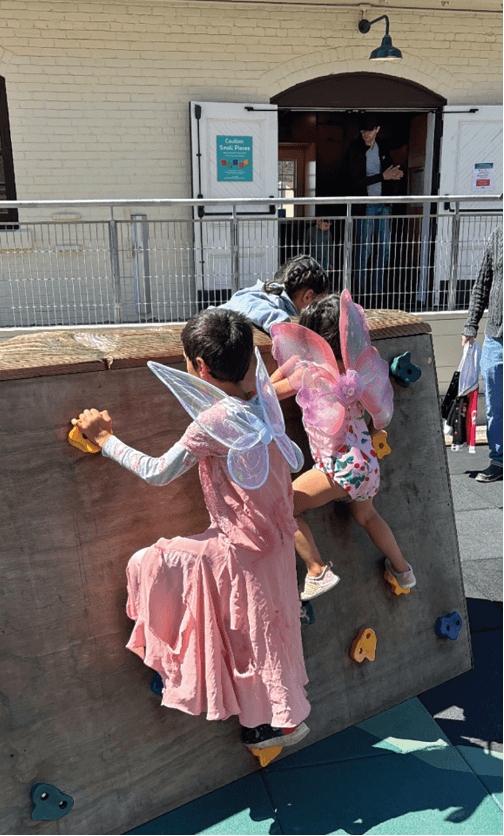
Leah, three, Harvey’s sister, wore a colorfully patterned bathing suit, also fitted out with wings. A pair of slip-on pink shoes completed the outfit.
The two ran, danced, jumped through San Francisco International Airport as we made our way to our flight to Portland, where they lived. Passersby beamed at them, delighted by the childhood exuberance wrapped in magical clothing. A few asked if they were angels or fairies.
“Fairies,” Harvey solemnly replied.
They weren’t really either. They were just them.
Harvey and Leah had made a quick visit to the Bay Area to see extended family. Their Bubby — my sister, Marissa — had accompanied them from Portland, their first-ever plane trip without their parents. I was to accompany them home.
At my house Harvey asked if he could play dress up. I introduced him to the boxes of costumes my family had collected over the years, from Halloween celebrations and visits to Burning Man. He excitedly pulled out the options, trying different things on, until settling on the dress, the wings, and a scarf featuring dangling faux metal coins.
“Put this on,” he told me, handing me an embroidered Moroccan caftan. “I promise not to tease you.”
With some difficulty I pulled it over my head and shoulders. It wasn’t comfortable, nor my preferred drag, which, when activated, tended towards a kind of genie vibe. When I opened the door for my nephew, Asa, he burst out laughing. Pretty soon he too was sporting a sparkly caftan. It looked good on him.
A couple of decades earlier, my wife Debbie, Sara, and I had spent several months in Kerala, India. The noisy streets burst with the smell of incense, tuk-tuk exhaust, and cow dung. Women hurried on their errands in a rainbow of distinctly hued saris, a swirl of color. We’d had a similar experience when we lived in Niger, West Africa, which featured even more vibrantly patterned boubous.
“Why are Americans so afraid of color?” Debbie asked me. “We’re all browns and blacks. Look at this; it’s awesome.”
Even in San Francisco, a relative bastion of personal expression, we tend toward conformity. Tech bros wear plain, dark T-shirts and reasonable slacks. Women are similarly minimalist, with the daring outfitted in blazers over their Everlanes. It’s the too-busy-solving-important-problems-to-think-about-clothes look. Pacific Heights soirees fashion is dominated by undiscernible shades of black.
Yet San Francisco makes ample room for body statements; wrap-around tattoos, piercings aplenty, jacked-up physiques with bicep veins popping. Fashion is about messaging meaningful transformation, related to identity, politics, or belonging to a clique. What’s less acceptable are makeovers with no deep meaning; a five-year-old in wings, dressing-up for the sheer joy of the costume.
The sight of two joyous children prancing through an international airport wearing butterfly wings, a dress, and a bathing suit was enchanting in part because it’s so unusual, and so happy. These kids weren’t posturing about anything; nothing virtuous was being signaled. They were just having their own kind of non-serious fun.
Harvey had wanted me to join him, to wear the caftan he’d picked out for me, on the airplane. I declined. Now I wish I hadn’t. It would have added to the joy.
