
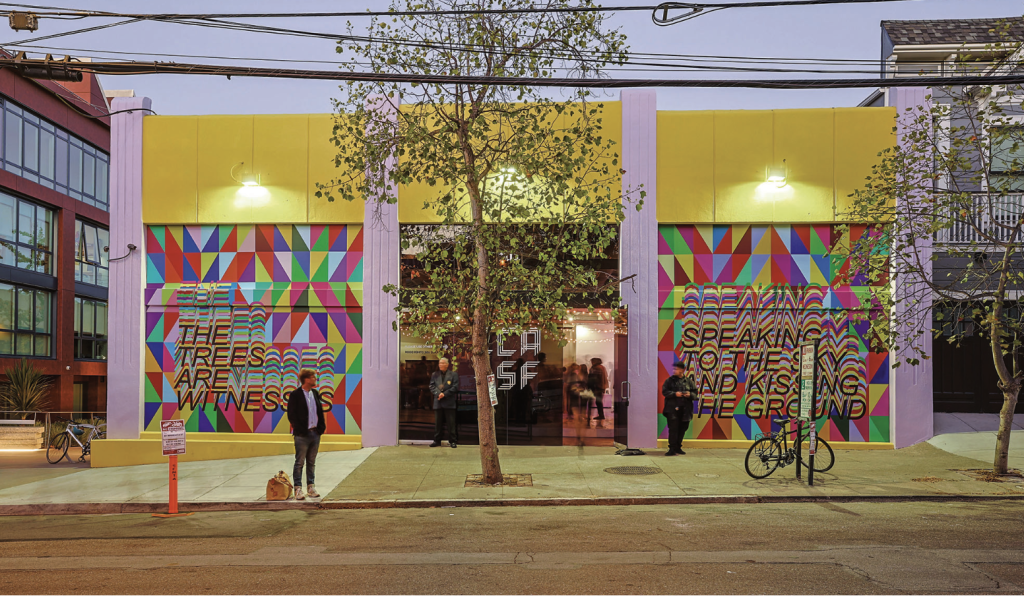
According to The Institute of Contemporary Art San Francisco’s (ICA SF) founding director, Ali Gass, the always-free, non-collecting museum was conceived amidst the depths of the pandemic and racial reckonings of 2020.
“The vision was to offer extraordinary arts and culture that helps audiences navigate the cultural, social, and political cultural issues around us, in a way that is free to everyone,” said Gass. ICA embraced the Bay Area’s startup ethos to be “a nimble center that responds to the moment.”
In July and August, the museum will be occupied by Meantime, an initiative that focuses on artists’ lack of access to space through residencies, educational workshops, performances, and popups.
ICA complements the nearby Minnesota Street Project, which offers accessible spaces for galleries, artists and related nonprofits. Minnesota Street Project founders, Andy and Deborah Rappaport, were lead funders of ICA SF, investing $1 million in 2021. The Rappaports also helped secure the lease for the museum’s building, on Minnesota Street between 20th and 22nd streets, which’d previously housed MySpace. Venture capitalist Andy Rappaport is a partner emerita at August Capital.
In 2022, Pamela and Dave Hornick donated $1 million. Dave Hornick is a general partner at Lobby Capital; wife Pamela serves on the Director’s Advisory Board of Cantor Arts Center. After an additional $2.5 million was raised ICA opened in the fall.
“There are ICAs in Boston, LA, and Miami. Most great contemporary art cities have different kinds of museums and art spaces: university art museums; local, nonprofit museums; or ambitious non-collecting museums, known in Europe as kunsthalles, that allow contemporary artists from all over the country and world to push their practice,” Gass said.
A Potrero Hill resident, Gass moved to the Bay Area in 2005. She previously served as assistant curator of painting and sculpture at the San Francisco Museum of Modern Art and chief curator at Stanford’s Cantor Arts Center. In 2017 she became director of the University of Chicago’s Smart Museum of Art. She returned to San Francisco during the pandemic.
The ICA’s board is composed of collectors, tech founders, and venture capitalists, who help raise $2.7 million a year for the institution.
“Between the Minnesota Street Project, contemporary art galleries, and the proximity to the Wattis Institute, the Dogpatch is becoming a significant arts and culture destination,” Gass said. “It’s a place where you can come and spend an entire day seeing contemporary art; being able to add to that feels really important.”
The museum hosts food and coffee popups, family day programs like Children’s Studio, and educational curriculum in collaboration with Bayview, Dogpatch, and Potrero Hill schools.
ICA is participating in efforts to refurbish the Dogpatch Community Court, located on the same block as the museum. The basketball court is one of more than 90 the Warriors Foundation has renovated to support youth development. Originally reconditioned in 2016 in partnership with Alive & Free – a San Francisco violence prevention program – the court will soon feature public artwork by artist Patrick Martinez.
The museum space can be rented for events.
“We’ve done everything from 50-person dinners to 150-person graduation parties, and smaller corporate meetings,” noted Gass.
This summer, food popups will be offered on Thursday evenings, with Calaca Coffee open Sundays from 10 a.m. to 2 p.m. On June 15, SUP!, an ode to Southeast Asian street food, will be available from 5 to 8 p.m.
 Jessica Zimmer
  Tracy Tanner
  PV Staff