
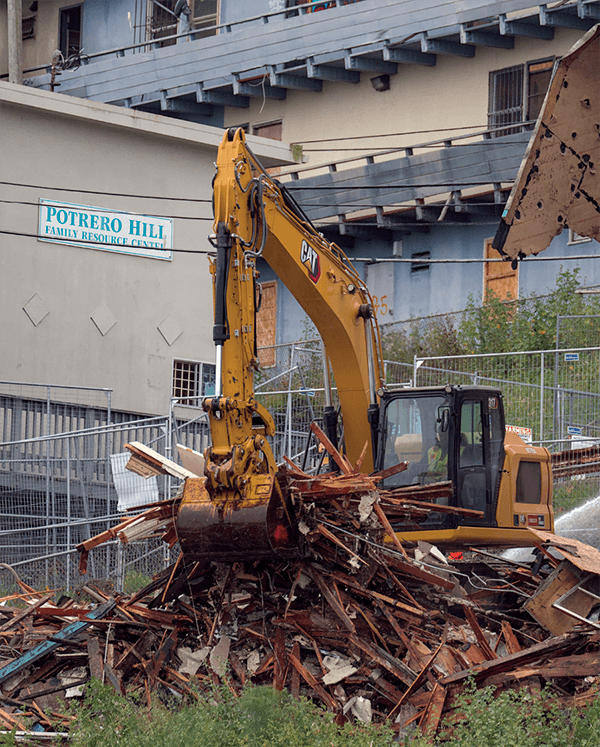
Potrero Annex’s demolition is finally underway, a major turning point in the site’s slow crawl toward the rebirth promised by HOPE SF when it was launched nearly 20 years ago.
According to Anne Stanley, Communications Manager for the Mayor’s Office of Housing and Community Development (MOHCD), next phase work will involve 23 buildings on Turner Terrace, Watchman Way, and Missouri Street. Several steps were taken before demolition began, including relocating all Annex residents and clearing unhoused occupants by property manager Bell Properties, San Francisco Housing Authority (SFHA), and MOHCD. Utilities were shut off and fences placed around vacant structures, with plywood in some areas to assist in mitigating noise.
Albion Partners, an environmental consulting project support firm established in 2010, tested the buildings to determine what and how hazardous materials will be removed, a process known as “abatement.” Albion is also responsible for air monitoring during demolition and construction, sharing weekly reports with the community online at rebuildpotrero.com.
Following abatement, demolition will commence east of Missouri Street. The buildings will be taken down to their slabs, with foundations and streets left in place.
Working hours are from 7:00 a.m. to 3:00 p.m. with no major street closures planned or truck routes affecting the public transit availability.
Stanley said demolition activities could extend to next February, after which a new, yet to be selected, master developer will update timelines for the remainder of the Rebuild Potrero project. Before additional demolition can begin, however, the 129 households that remain at Potrero Terrace will be relocated to newly completed buildings onsite, or if no unit meets household size requirements, to another HOPE SF location.

Phase 1, construction of 1101 Connecticut – formerly Block X – was completed in 2019. Phase 2, which encompassed implementing Block A infrastructure – a market rate parcel awaiting development – and Block B – Eve Community Village – was finished last year.
Phase 3 delays date to 2022, when the Eugene Burger Management Corporation (EBMC) was managing the property, doing little to prevent squatters from occupying empty units, circumstances which San Francisco Fire Department officials believe contributed to the death of 40-year-old Richard Gescat in a fire inside one of the vacant units.
Demolition marks a further distancing from an era that began in 1941, when the Terrace units were constructed to fill the housing needs of a wartime work force, with most residences occupied by those employed as ship builders.
The 38-acre site offers dramatic views of the Oakland Hills and San Francisco Bay. To build there, “benches” were cut into the hillside in shapes dictated by the earth itself. Streets followed, abandoning the traditional City grid, setting the development apart from its neighbors.
The Annex was built in 1955 to serve as low-income housing, adding another 137 units in 23 buildings on just more than seven acres. Originally described by SFHA as “marginal land which perhaps otherwise would have laid undeveloped for many years,” the choice to build was made because sites were becoming increasingly difficult to find.
According to an Historic Resource Evaluation conducted in 2011 by the San Francisco Planning Department, addition of the Annex magnified the development’s differences from surrounding neighborhoods. The report blames the steep slopes for crowding and irregular building placement, indicating that its position on the opposite side of a valley crest that defines the original bowl-shaped site disconnects Annex visually and spatially from Terrace.
The demographics of Annex-Terrace’s 1,300 residents—which once included O.J. Simpson and Danny Glover—changed over time. Unemployment increased, along with the complex’s poor reputation. According to BRIDGE Housing, violent crime at the housing complex was five times the City average in 2017, with residents reporting daily gunfire.
 Moumita Chakraborty
  Jessica Zimmer