
San Francisco steadily, and sometimes rapidly, changes. New restaurants arrive and existing ones close. Families move in and out. Structures are torn down, replaced by new buildings.
Daniel Wall grew up on a Potrero Hill that was noisy with factories, well-used bus stops, and kids playing on steep streets. He lived with his parents, Cornelius and Valentina, and siblings, Diane and Carol, on Connecticut Street, across from St. Teresa’s Church.
Wall recalled that where Goat Hill Pizza now sits was once the Corner Creamery, a malt shop with a jukebox, pinball machine, and long counter. The 22-Fillmore bus stopped outside; disembarking passengers often drifting in before heading home. Kids scraped together coins for ice cream. Adults lingered. Seniors visited with their grandchildren.
“It was a meeting place,” he said. “That’s what mattered.”
Wall grew up in the 1940s and 1950s, when the Hill was a working-class home to a mix of ethnicities. The Potrero Annex-Terrace housing complex was racially integrated, dominated by shipyard workers, including Black families drawn by wartime jobs. Russian households clustered near the Wisconsin Street firehouse. Irish, Italian, Portuguese, and Hispanic families lived between 17th and 20th streets.
Wall’s friends attended Daniel Webster Elementary or St. Teresa’s Grammar School. Children from different backgrounds had fun together without much thought.
“You didn’t think about it,” Wall said. “You just played.”
Young people gathered at Jackson Park or the Arkansas Street playground. They fished at Mission Bay, catching smelt, bullheads, and small sharks that couldn’t be eaten because the water was too polluted. They made their own entertainment. A favorite involved a wooden board, bar of soap, and Arkansas Street. The soap slicked the board’s bottom enough to send a child sliding downhill like a homemade sled. Roller skate wheels were scavenged to build crude coasters. Tall grass grew on vacant lots, perfect places to play hide-and-seek.
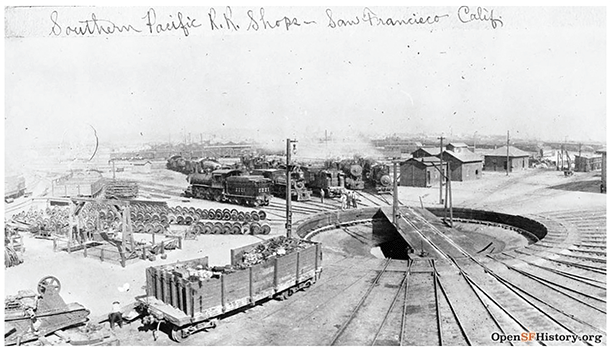
At the bottom of the hill, industry ran day and night: American Can Company, concrete plants, freight trains, and Southern Pacific’s roundhouse, where locomotives rolled onto a turntable and were spun into service bays adjacent to Mariposa Street. Wall and his friends wandered through stored passenger cars and cabooses. Once, a train engineer waved two kids into the cab and let them ride the locomotive onto the turntable before kicking them out.
“Don’t come back,” the man told them. They didn’t.

Wall’s father, Cornelius, arrived in San Francisco after World War II. A Navy veteran and electrician, he worked as a presser at Lilli Ann, a women’s garment manufacturer located in the Mission. He joined the International Ladies Garment Workers Union and rose through its ranks, eventually becoming a vice president.
Cornelius led efforts to increase wages at Chinatown sweatshops. He organized national labor unions to pressure those that wouldn’t improve conditions to close. His advocacy provoked enough backlash that armed guards sometimes stood outside the family home.
Later, Cornelius was appointed to the City’s grand jury and served on several commissions. Daniel recalled a luncheon in Chinatown held in his father’s honor, attended by municipal leaders and factory owners. He mostly remembers the shrimp.
Still, money was tight in the early years. Houses weren’t grand. Wealth wasn’t a topic of conversation. Parents worked. Kids roamed.
Wall followed his father into the Navy, joining the reserves at Treasure Island in 1964. He transferred to Alameda Naval Air Station, trained as an electrician, and stayed for more than two decades. He retired in 1985 as a master chief.
Cornelius and Valentina moved to Culver City in the early-1970s. When Wall returned to Potrero Hill after years away he noticed changes but not a transformation. Trees had been planted along sidewalks that once stood bare. Daniel Webster, his alma mater, had been rebuilt. There were new merchants, including The Good Life Grocery and Farley’s, now neighborhood stalwarts themselves.
“The houses are the same,” he said. “The streets are the same. The feel is the same. “I don’t think it’s changed much at all. Not where it counts.”
Wall lives in San Ramon, visiting San Francisco occasionally for a San Francisco Giants game or to drive past his old block. Sometimes he stops. Sometimes he doesn’t.
He talks about the Hill the way people chat about a finished thing. Not frozen. Just settled. A place that gave him what he needed when he was young: parks, streets, friends, work nearby, and a lot of room to figure things out.
“I wouldn’t change a thing,” he said.
 Rebekah Moan
  Moumita Chakraborty
  Jessica Zimmer