
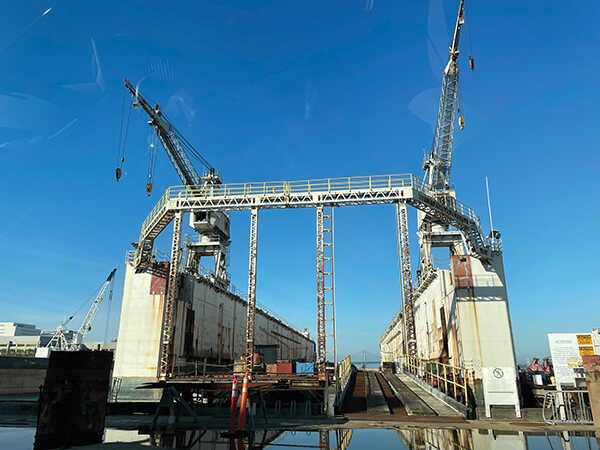
The Port of San Francisco has directed global engineering firm GHD to draft a demolition plan for two prominent ship repair structures – Eureka Drydock and Drydock Number Two – at Piers 68-70. GHD, an Australia-headquartered multinational specializing in environmental and engineering solutions, will oversee the decommissioning strategy for the waterfront site.
Eureka Drydock is 570 feet. Drydock Number Two, also known as DD2, is 900 feet, larger than any of the Port’s piers and bigger than the Ferry Building. Pollock-Stockton Shipbuilding erected Eureka in 1945. Bethlehem Steel Corporation built DD2 in 1970. The long-inactive drydocks were determined to be unrepairable after suffering catastrophic structural damage during severe storms last November.
The Port originally shuttered the facilities in 2017. Severe weather worsened fractures and opened new tears in the metal hulls, which triggered uncontrolled flooding inside Drydock No. 2, causing the colossal steel structure to take on water and dangerously list to one side.
“(GHD) will prepare preliminary engineering plans for demolition of both drydocks and assist with securing necessary permits. The preliminary design package for the demolition work…will be used for permitting purposes and to advertise for a future design‑build contract,” said Eric Young, Port of San Francisco spokesperson.
The Port expects initial plans to be completed by next March, with a contract for demolition work tendered the second half of 2027.
“The removal of the dry docks creates opportunities to reimagine new uses for that section of the waterfront. Any future uses will comply with the Port’s Waterfront Plan and Strategic Plan…will involve community and stakeholder engagement,” said Young. “The demolition contract will include requirements for mitigating…risks, such as containment measures, noise controls, air‑quality protections, and safe work zone practices.”
Young said it was premature to speculate about what future uses could be contemplated for the area that the drydocks currently occupy.
Demolition signals the end of an era previously marked by the rhythmic clanging of heavy iron and the towering profiles of massive ocean liners on the southeastern waterfront. While large-scale commercial ship repair has completely vanished from San Francisco, a resilient pocket of maritime industrial work survives downscaled at San Francisco Boatworks adjacent to Crane Cove Park. The transition highlights a stark reality for the City’s blue-collar history: San Francisco can still fix a hobbyist’s sailboat, but it can no longer service the global shipping fleets that built its economy.
Port officials rushed to patch holes and tears corroded into the dry docks’ steel hulls, according to Young. Because dry docks rely on a ship-like hull to stay buoyant, the emergency welding was required to keep the massive structures afloat until demolition crews arrive.
“The project installed temporary pumping systems to remove water as the patches were still in the process of being installed. The project will install a monitoring system to keep an eye on the draft…and alert Port staff if it senses excessive listing,” said Young.
DD2’s shore-power electrical equipment may be sold for salvage, depending on retrieval costs.
“While there are no current analogous situations elsewhere on Port property, the drydock project does underscore the need for ongoing condition assessments and timely repair work for all in-water structures. The Port has a robust assessment program…frequently works closely with tenants regarding potential maintenance and improvement plans based on the responsibilities set forth in the relevant leases,” said Young,
Young explained that the drydocks weren’t initially owned or operated by the Port, but by a tenant, BAE Systems.
“BAE Systems operated both drydocks until 2016 when BAE Systems San Francisco Ship Repair, Inc. sold their right to operate the yard to Puglia Engineering, Inc.,” said Young.
Shortly after the acquisition closed, Puglia sued BAE Systems, claiming the company committed fraud by hiding the drydocks’ true condition and masking the need for shipyard dredging. Following the legal fallout, the Port issued multiple solicitations for a new operator in 2017 and 2018 but received no credible bids.
“Given these results and the underlying economics of ship repair, the Port has no expectation of reopening the Shipyard,” said Young.
“We’re wondering how this could have been prevented,” said Katherine Doumani, a Dogpatch Neighborhood Association member.
Doumani is concerned that DD2 is leaching toxic sediments, though Young said there’s no indication that’s occurring.
“This is reminiscent of the east half of Crane Cove Park that was never built; just quietly ignored by the Port. Who’s running this operation? Why is no one seemingly responsible? We’re questioning whether this is due to the fact that there is no current executive director for the Port. The acting executive director is Michael Martin. He answers to the Port Commission. So, what was their duty here?”
 Lori Higa
  Rebekah Moan
  Danny Pham