
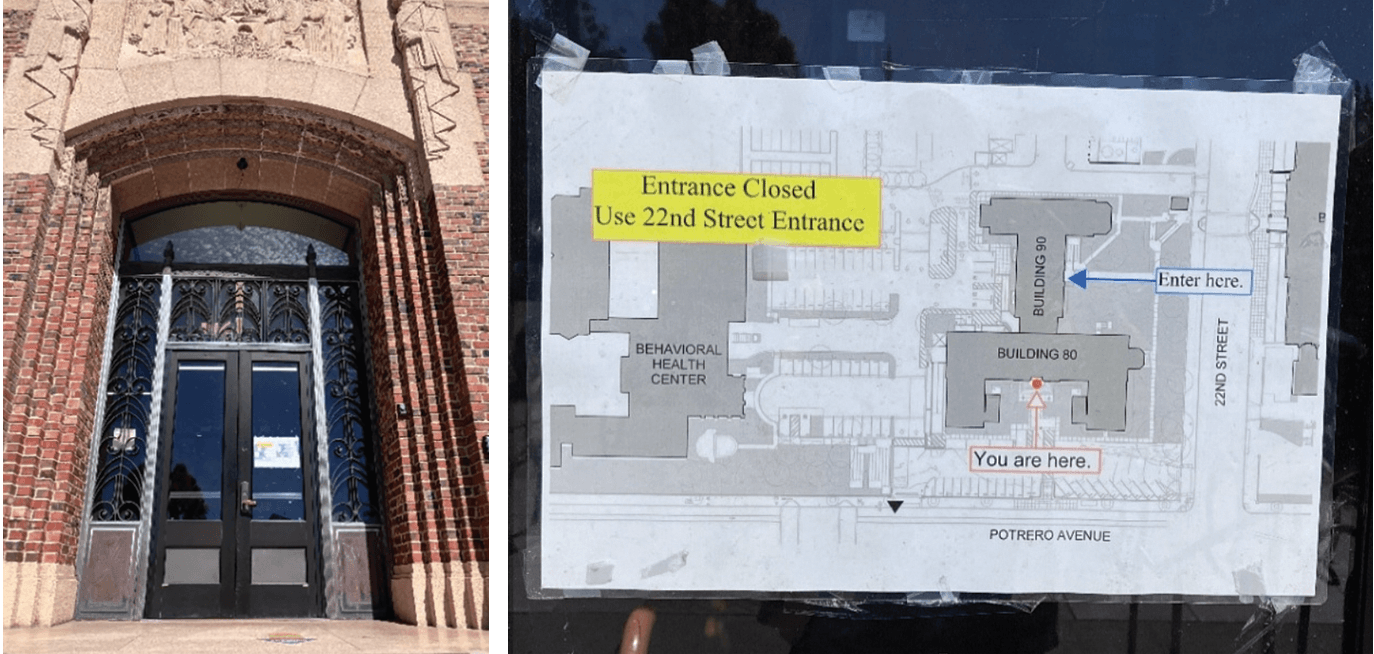
The stabbing of 51-year-old social worker Alberto Rangel in Ward 86 at Zuckerberg San Francisco General (ZSFG) prompted numerous security-related changes at the hospital. According to Gail Smith, an 81-year-old patient at the cardiology clinic in the same building Rangel was murdered, the modifications have erected a gauntlet of hurdles that make her visits much more difficult.
Before the December 2025 incident, Smith entered the building through the front doors facing Potrero Avenue. The cardiology clinic entrance is just inside to the right, about ten feet from entry. That access, along with another, has been permanently converted to an exit only. The only way into the structure now is through a 22nd Street door, where a full security station enables San Francisco Sheriff’s Department (SFSD) officers to monitor visitors with a metal detector.
The new configuration forces Smith, who has mobility issues, to travel an additional 250 feet. Once inside the building, she’s has to take the hallway back toward the front door, additional steps which she said are challenging to her ailing body.
A California Division of Occupational Safety and Health (Cal/OSHA) investigation following the fatal stabbing determined that changes were necessary to meet safety standards. In their 38-page report, inspectors identified numerous problems, fining ZSFG $273,200 for multiple violations, including a failure to ensure “…security staffing was sufficient to address the workplace violence hazards in Ward 86 and the Bridge Clinic” or “… to effectively address the sufficiency of security systems, including clams, emergency response, and security personnel availability during its annual reviews…”
Tara Moriarity, SFSD spokesperson, declined to comment about the new security measures and said in an email that they “are referring all inquiries on this matter to the City Attorney’s Office.”
Jen Kwart, communications officer for City Attorney David Chiu, thanked the View for reaching out, then added, “I believe DPH is going to send you some information about security.”
An email to the Department of Public Health was answered anonymously and included the following statement, with a directive to credit it to “the San Francisco Department of Public Health (SFDPH).”
“Day in and day out our frontline healthcare workers deliver critical, life-saving care under demanding conditions and they deserve to do so safely, with the protection and support they need. Following the tragic death of our colleague Alberto Rangel at Ward 86 at Zuckerberg San Francisco General Hospital on December 4, 2025, the San Francisco Department of Public Health took immediate action.”
The statement outlines numerous such actions, such as convening a 100-person team of SFDPH and University of California San Francisco staff, who “made rapid improvements to better protect staff and patients, while also advancing long-term structural changes.”
In addition, the anonymous writer asserted, “(t)he department welcomed and fully cooperated with a thorough review from Cal/OSHA. The findings are in line with our own rigorous internal assessment. The vast majority of their findings to overall safety and security have been addressed, some within days of the incident. Countless additional security measures have been initiated or expedited to strengthen workplace safety, including enhanced physical security measures, expanded security staffing, increased crisis prevention and response training, and a fundamental change in security structure governance to better connect leadership to frontline staff and their concerns.”
These statements appear to be at odds, however, with the views of representatives from the University Professional and Technical Employees (UPTE). In the immediate aftermath of the stabbing, the union issued a statement that workers have repeatedly raised concerns about safety in the workplace, claiming that “a recent survey of campus behavioral health workers in UPTE, 90 percent reported having experienced some threat, assault, or intimidation while on the job. In over half of the cases where safety concerns were raised with management, the response was slow, unsatisfactory, or retaliatory. 71 percent of those surveyed said they have considered leaving their jobs because of safety concerns.”
“The basic safety improvements being made at SFGH are long overdue,” a union spokesperson said in an email exchange with the View. “We appreciate that the City is taking responsibility for infrastructure changes and engaging in open dialogue with frontline workers. But a UCSF worker was killed, and more than six months later, UCSF has done nothing. They have failed to take responsibility for the safety of their employees or productively engage with city leaders and frontline staff to find a resolution. This negligence continues to put our workers’ lives and all San Francisco residents at risk, and we will continue to fight for the basic safety measures until every worker and every patient knows they will come home from SFGH safely.”
Concerns about the Sheriff’s Department’s handling of hospital security are longstanding. In 2013, patient Lynne Spalding went missing from SFGH for more than two weeks before she was found dead in a stairwell. A federal review found the search deputies conducted covered only half the building’s stairwells, despite staff having been instructed to look everywhere. Investigators also found deputies failed to follow up on an earlier report of someone lying in a stairwell. Transcripts revealed confusion between the department and hospital staff over Spalding’s description during the search. The episode prompted a staffing shake-up within the department’s hospital unit.
The number of sheriff’s deputies stationed at SFGH had been declining for years before Rangel’s death; from 45 in 2022 to 28 by the time of the attack, according to the San Francisco Deputy Sheriffs Association. The reduction stemmed from a Department of Public Health policy shift, driven by concerns about disproportionate use of force against the hospital’s patient population, that replaced sworn deputies with health department-employed security cadets and additional healthcare staff. In 2021 Labor representatives cautioned that the reduced security presence would eventually lead to a worker being seriously hurt or killed; a warning that was documented in an email from an SEIU steward to the Sheriff’s Department.
Meanwhile, Gail Smith has waged her own battle for reasonable access, through the hospital’s “Patient Experience” feedback system and calling 311 to register her complaints. Lack of progress on both fronts led her to contact the View.
An officer with Marina Security Services, one of the firms providing support to SFSD at ZSFG, told the View that an administrative request can be made for Smith to enter the building through the front entrance on Potrero Avenue.
When given this information, Smith said she’d already tried that and been told by a security supervisor that such accommodation wouldn’t be made, even with a letter of support from her cardiologist.
“I really think they should just move the clinic out of that building to the main hospital,” Gail said with a sigh. “That would solve the problem.”
 Moumita Chakraborty
  Jessica Zimmer
  PV Staff