
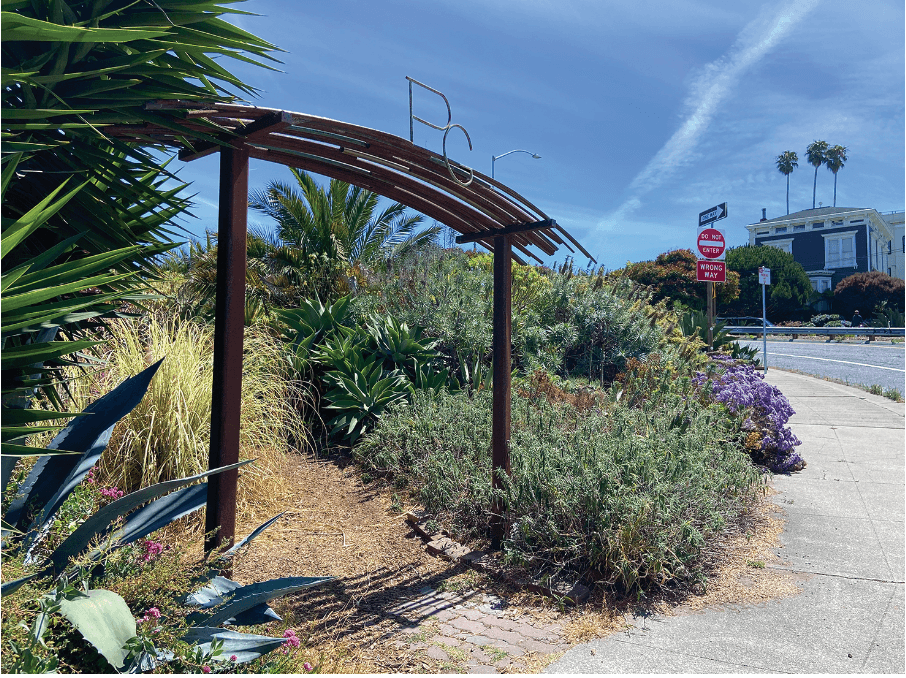
For eighteen years, Annie Shaw, her husband Matt Petty, and other Potrero Hill residents have dedicated themselves to beautifying and maintaining land that’d been neglected and filled with detritus. As a result of their efforts, Pennsylvania Street Gardens has emerged as a green oasis, an inviting space to take a break with a cup of Linea coffee or walk off a pancake breakfast from Plow.
Shaw had imagined the irregularly shaped 18th and Pennsylvania lot, just off the John F. Foran Freeway off-ramp, as a relaxing, safe place for neighbors.
“The green light really came on when I saw a Princess plant suddenly planted there,” Shaw said, “At first, it really was a guerilla garden. We bought all the plants we could and put in thousands of hours to clear the land for them.”
The plot’s owner, the California Department of Transportation (Caltrans), was initially hostile to the nascent garden, viewing it as a potential liability. Shaw organized a petition and appealed to Caltrans, successfully convincing the department to allow the effort to continue. PSG became the first ever San Francisco street park on Caltrans land. The initial five-year contract to maintain it has been renewed ever since.
Soon after, the San Francisco Department of Public Works (DPW) launched a program to allow communities to create gardens on its properties, piquing PSG’s interest. A stretch of DPW land, which was then on an “unaccepted” street between 17th and Mariposa, was a natural addition to the main Pennsylvania Garden. It took about two years for cultivation to start at what’s now known as the Pennsylvania Railroad Garden. The PSG team went through a public comment period, securing official permission and grants; different from the renegade approach for the Pennsylvania Garden.
In 2012 and 2013, the PSG team installed sidewalks, boulders, 23 trees, thousands of plants, a seating area, and signage at the Pennsylvania Railroad Garden. At the behest of the Potrero Hill Garden Club, PSG adopted the Triangle Garden, located at the 280 turnoff onto 18th Street. Today, the Pennsylvania Street Gardens stretch over two blocks between 17th and 18th Streets, consisting of the original Pennsylvania Garden, Pennsylvania Railroad Garden, and Triangle Garden, providing wildlife habitat and breathing room for humans.
The freeway, built in 1972, created years of leaded gas runoff into the soil; asphalt remnants can still be found in the gardens. Shaw tested many types of plants to see which would thrive. With potential soil contamination, edible plants were out of the question. Lack of easy access to water sources favored drought-tolerant plants. The gardens now boast more than 300 genera of plants which do well with rainwater, including agaves, aloe, and yuccas.
“We’ve really invested in striking a balance between native, drought resistant, and more exotic plants. Sustainable practices are also something we continually iterate, such as choosing not to use plastic weed barriers which compact the soil and would affect water needs,” said Shaw.
Like many community-based greening efforts, PSG was adversely affected by San Francisco Parks Alliance’s abrupt closure last year.
“There were some warning signs, with access to our funds becoming slower and slower,” Shaw said, “Questions from us and other park stewards went unanswered as well.”
PSG lost a significant amount of funds in the dissolution.
“Annie put out an open call in November last year, and the community sprang into action to help replace 80 percent of what we had lost,” volunteer Jennifer Benz noted, “But the most immediate need was to find another fiscal sponsor, an organization which could hold and manage funds, allowing us to operate as a 501(c)3 nonprofit, and provide necessary insurance.”
Benz helped secure a fiscal agreement with Greening Project, which sponsors several other parks and gardens in the City.
”We might think we are just focusing on creating green spaces where we can, but we are building a community of gardeners and stewards who are there to lift us up and inspire us,” a recent Greening Project statement reflected, “So, the next time you find yourself wondering how you can make a difference, remember this: you are part of a much larger, vibrant tapestry of gardeners across San Francisco.”
“We’ve very much been an ‘if you know, you know’ neighborhood gem,” Shaw said, “But expanding our formal connections within the community will expand necessary volunteer and financial capacity.”
The neighboring 249 Pennsylvania Avenue parcel, previously home to Center Hardware, has been vacant since the building was demolished in 2019, following the site’s sale by prior owner William Spencer Company. Tenderloin Neighborhood Development Corporation acquired the land in 2023 through the Community Opportunity to Purchase Act. TNDC and Young Community Developers are jointly developing the parcel into a nine-story affordable housing complex with 124 residences.
The project was approved by the San Francisco Planning Department in April. The developers have worked through a multi-layered financing process — including acquisition and predevelopment loans and a municipal Notice of Funding Availability — to assemble the multi-million-dollar funding needed to offset below-market-rate rents. Once built the structure will back directly onto the freeway, with plans to add trees and gardens along Pennsylvania Street.
“We do hope that the development will partner with us to maintain the current park and for us to contribute to the garden plans on the Minnesota-facing side, especially as it’s now just broken asphalt,” Shaw said.
Shaw stressed that gardening never ends. Plants die, are burned, or stolen. Weeds pop up, animal waste is left on paths despite installation of trash receptacles; unhoused encampments recur in pockets of the park. Volunteers have built paths, steps, and benches which need to be maintained and replaced due to human or natural causes. Sidewalks or brick buckle, gravel pathways erode in rain or other weather, graffiti covers signage and benches.
“We’ve been a wholly volunteer-led and run group since 2008 and have welcomed thousands of volunteers over the years. Since COVID, though, this base has waned.” Shaw said. “It’s always interesting to hear how folks find us, whether individuals or community associations or corporate teams.”
In July, One City Day brought dozens of volunteers to PSG, some veterans but many of them new.
“I was looking for something I could do which was hands on and came across PSG while browsing the list of projects,” Lauren noted, “So the chance to get down in the dirt was appealing, and it’s been so interesting to chat about what brought others out here and learn about the ethos of the garden.”
“It’s definitely different from getting together over a meal, and we’re looking forward to exploring the neighborhood more after this,” said another volunteer.
“It’s great stress relief to pull up weeds and make things nice for the neighborhood to enjoy – we know you come by! – but really, it’s a good way to stop staring at a screen and connect with my community,” said another.
“Community partnership and funds would go a long way to making the paths wider and more stable with rock and granite so they can handle more foot traffic,” Shaw said.
A huge agave at the corner of the Triangle Garden bloomed and died, prompting a redo of the area. DPW removed the agave stump, cleared dead brush, and put down mulch. The PSG team added native trees, plants, and rock, primarily through volunteer efforts, with plans to finish planting during the fall rainy season.
“The gardens are meant to be a neighborhood space,” Benz explained, “but we want the Triangle Garden especially to be a kind of welcome sign to those coming into Potrero.”
PSG has a small amount of funds in reserves, but with mounting responsibilities and dwindling volunteership, the organization is eager to restart fundraising and community awareness efforts. While there are several grants available to develop new gardens, monies to support maintenance is scarcer, with increased reliance on individual monetary or plant donations and volunteer time and expertise. Maintaining the garden costs roughly $25,000 a year. Emergency or special projects, like replanting the Triangle Garden, can demand more than $50,000 for materials alone.
“We’ve had nearly twenty years to stretch the resources we can get and make up the rest with grit!” Shaw quipped.
 Mark Steensland
  Jessica Zimmer