
One hundred years ago, the Potrero Boosters Neighborhood Association – the Boosters – first started promoting the interests of what at the time was a working-class immigrant enclave. An early accomplishment was development of Fallen Bridge Park at 531 Utah Street, in 1971, with the assistance of District 7 Supervisor Robert Gonzalez. In 2005, the Boosters successfully encouraged the San Francisco Municipal Transportation Agency (SFMTA) to establish Residential Parking Permit Zone X, which covers Potrero Hill, and to reconfigure Zone W, in the Mission, which limited non-residents from parking all day in these areas.
The social welfare organization’s centennial is marked by a change in leadership, with Connecticut Street resident Lisa Ryers taking over as president from J.R. Eppler, who is running for District 10 Supervisor. Eppler will serve as external vice president, relinquishing the presidency after 13 years, performing presidential duties when Ryers is unavailable.
Donovan Lacy, Dogpatch & Northwest Potrero Hill Green Benefit District (GBD) executive director, is Boosters secretary. Kate Blumberg, a 22nd Street resident, is treasurer. The 501(c)(4) Boosters is working to recruit an internal vice president to serve as chief information officer and manage membership.
“The Boosters is in the process of identifying ourselves and who we want to serve for the next hundred years,” said Ryers. “The primary focus is “neighbor” with a capital “N.” We aim to serve the people who live here and their interests. That may include more social events.”
The Boosters have 70 members who pay an annual fee of $30 for an individual, $50 for a household or business.
In 2012, the Boosters formed a traffic calming team, which eventually became the Livable Streets Committee, a joint effort with the Dogpatch Neighborhood Association (DNA). The Committee works on issues relating to roads, parking and public transportation. Upwards of a dozen people typically attend monthly committee meetings.
In 2024, the Livable Streets Committee helped establish the 17th Street bike lane. Topics at recent meetings have included SFMTA’s budget and fiscal challenges, the implications of a possible parcel tax ballot measure, traffic calming proposals, and the siting of Level 2 electric vehicle charging stations.
The Boosters typically hold a monthly general membership meeting at the Potrero Hill Neighborhood House (Nabe) or Dogpatch Hub. San Francisco Police Department Bayview Captain Bernadette Robinson gave a presentation at a recent gathering.
The Boosters’ budget is roughly $3,000 a year, spent mostly on fees for meeting space rentals, snacks, community sponsorships, and an annual holiday party held in conjunction with DNA. The Boosters’ near-term goals include supporting rehabilitation of Jackson Park, which, according to Ryers, is at 75 percent of its fundraising goal.
“As (spots) like the Bernal Heights Playground continue to be rehabbed around the City, the Boosters will continue to elevate the importance of renovating Jackson Park as a community nexus, and connect the project to funding streams where possible,” said Ryers.
The Boosters have advocated for construction of the 22nd Street Steps between Texas and Connecticut streets. The project is split into two parts: steps from Texas to Missouri streets and trail steps from Missouri to Connecticut streets. The Texas to Missouri streets portion is part of an entitlement agreement with Align, developer of The Landing Apartments, located at 1395 22nd Street. The Missouri to Connecticut streets path will be built by Friends of Potrero Hill Recreation Center, fiscally sponsored by GBD.
“We have heard from Align that they are awaiting Public Works approval of the plans. They had a face-to-face with a Disability Access Coordinator. The work will take five months and could be built by end of year if Public Works approves the plans,” said Ryers.
The organization is working to make Illinois Street a “Safer Street” for bicyclists, pedestrians, and the roughly 31 percent of households that surround it that don’t own vehicles.
“The current bike lanes on Illinois Street are not safe topographically, with old rail tracks in some places. Also, bicyclists face dangers from large trucks frequently using the bike lanes as loading zones. We continue to lend our public support for this plan for a bi-directional protected bikeway which includes a four-foot buffer from being doored…this plan…could make all the difference in terms of safety and environmentally encouraging more people to bike versus drive in the neighborhood,” said Ryers.
The organization hopes to ensure that area infrastructure matches emerging development.
“On Potrero Hill alone, we have 425 studio units coming online next year at 300 De Haro. We have 1,700 homes under development with Rebuild Potrero/Bridge Housing rebuild of Potrero Terrace and Annex. We have 120 units proposed at 249 Pennsylvania. That is a lot of density on the horizon,” said Ryers. “Will these people have safe, protected paths of travel? Will these people have safe, functional parks and open space to connect to others and nature? Will these people have access to public transit that works for them? This is what we work to make happen by connecting needs with the agencies that can fulfill those needs and making those needs made clear.”
This year, the Boosters plans to take its gatherings “on the road.”
“We’ve hosted “History of Potrero Hill” and “Trees of Potrero Hill” walking tours, to connect neighbors to each other and the neighborhood. We also hold a monthly coffee meeting at Jackson Park on the first Sunday of the month, to meet with younger families and hear their concerns. This is on top of our regular monthly meeting,” said Ryers.
An emerging issue is increasing residential rents, partly due to development of the biotechnology cluster centered around the University of California, San Francisco’s Mission Bay campus, as well as the Artificial Intelligence (AI) boom.
“94107 has one of the fastest rising rents in the City. Friends who have lived here over 20 years, small business owners, and artists cannot pay the new rent dictated by a new owner when the property trades hands in the current rental bonanza. They have to move away from 94107,” said Ryers.
Ryers said there’s a concern about limited liability companies owning residential homes.
“When an LLC owns a residential home, there is often less engagement with the community at large, and they don’t live in the home full-time. They use the home primarily for work hubs for businesses and short-term rentals,” said Ryers.
Many homeowners place their primary residence into a single-member LLC for asset protection, estate planning, or personal privacy. These owners do live in the home full-time and engage normally with their neighbors.
Ryers added that the Boosters wants to make the neighborhood more equitable.
“We want to show (property owners) that where they’re buying or renting isn’t just real estate. They’re buying into a community,” said Ryers.
The Boosters’ 11-member development committee reviews proposals, meets with developers and municipal staff, and advocates for project improvements and community benefits, like funds for parks.
“Our current areas of focus include proposed amendments to the Pier 70 and Power Station Development Agreements, the proposed Amazon distribution center on Seventh Street, and the future of zoning in Showplace Square,” said Alison Heath, development committee chair and a member at large, a position that requires her to attend executive committee meetings and special sessions.
The committee doesn’t take formal positions.
“On the rare occasions when the organization does so, the decision is made by a vote of the general membership. As chair, I coordinate this work. I also help neighbors understand the planning process for smaller residential projects affecting adjoining properties,” said Heath.
“Being a part of the Boosters has helped me learn how to advocate for residents and pull the levers that get things done in the City,” said San Bruno Avenue resident Steven Solomon, one of two auditors and a Livable Streets Committee member. “I think it’s a great way to get to know other people in the neighborhood who share similar values and care about our City.”
Blumberg joined the Boosters because she saw it as a powerful organization that’s improved the community.
“I wanted to be a part of that. I think it’s important to work with developers to make sure they provide community benefits like greenspace,” said Blumberg, who was particularly proud of her work to make 17th Street safer for bicyclists and pedestrians. “That’s a tremendous showcase for the work the Boosters have been doing as to transportation.”
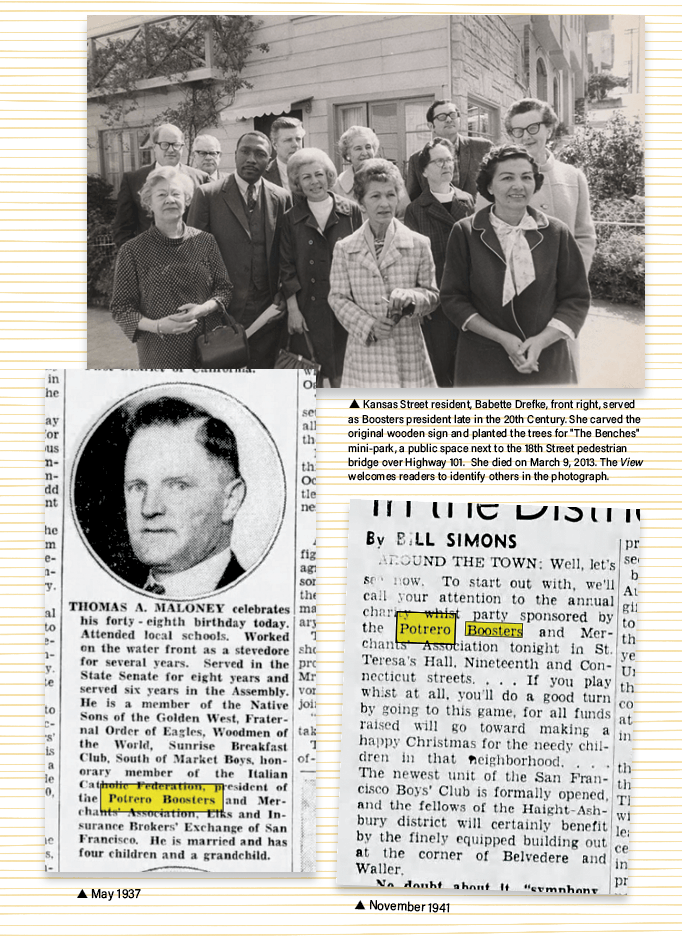
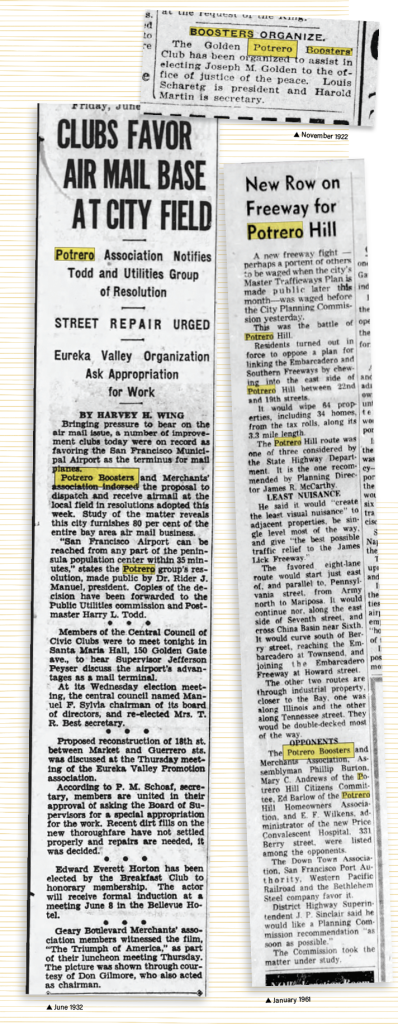
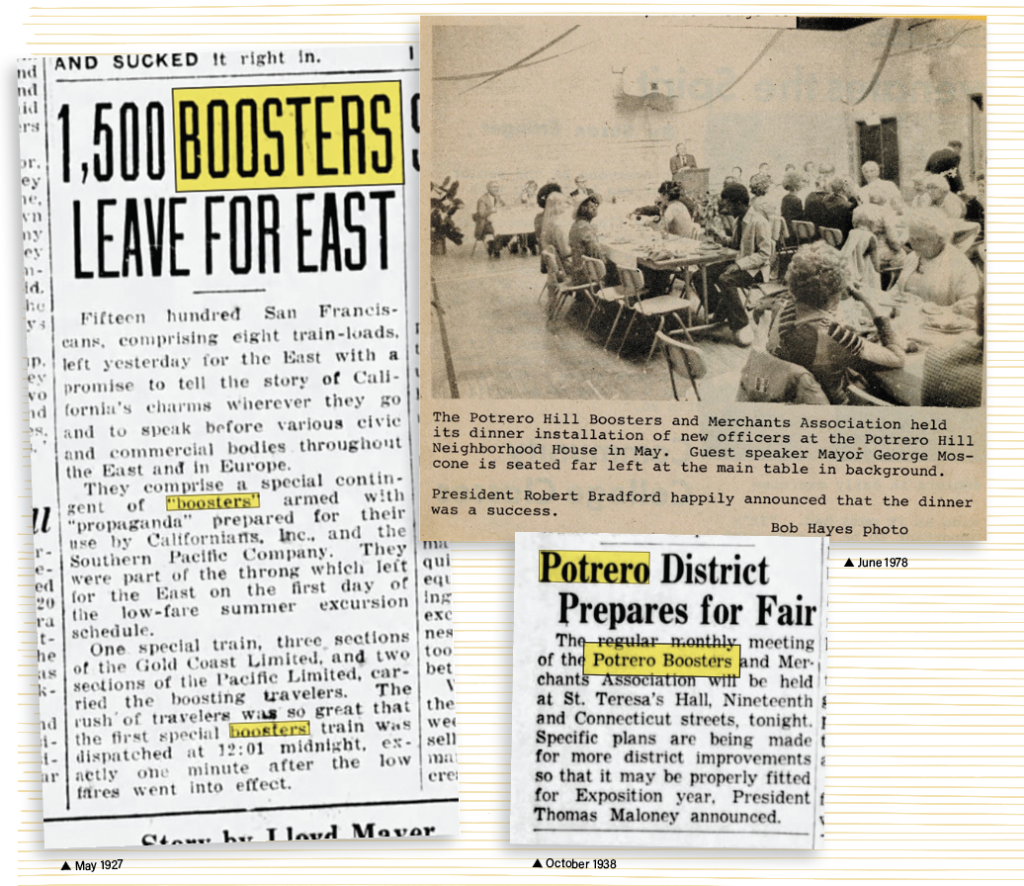
Peter Linenthal, director of the Potrero Hill Archives Project, said the Boosters formed at a time when cities were promoting business.
“San Francisco was getting afraid that Los Angeles was getting all the attention, with Hollywood and its sunnier climate. Individuals that supported the City and talked about living and doing business here came to be known as “boosters,”” said Linenthal.
According to Linenthal, the Boosters may have started even earlier, in 1921.
“We see mention in local newspapers of the Golden Potrero Boosters ball, a dance and social event,” he said.
The Boosters originally launched as a residential and business association; the Potrero Boosters and Merchants Association. Area businesses split from the Boosters to form the Potrero Dogpatch Merchants Association in 1989.
“Everyone is welcome. It’s a good way to meet people and understand how we can all work together,” said Ryers.
 Mark Steensland
  Moumita Chakraborty