
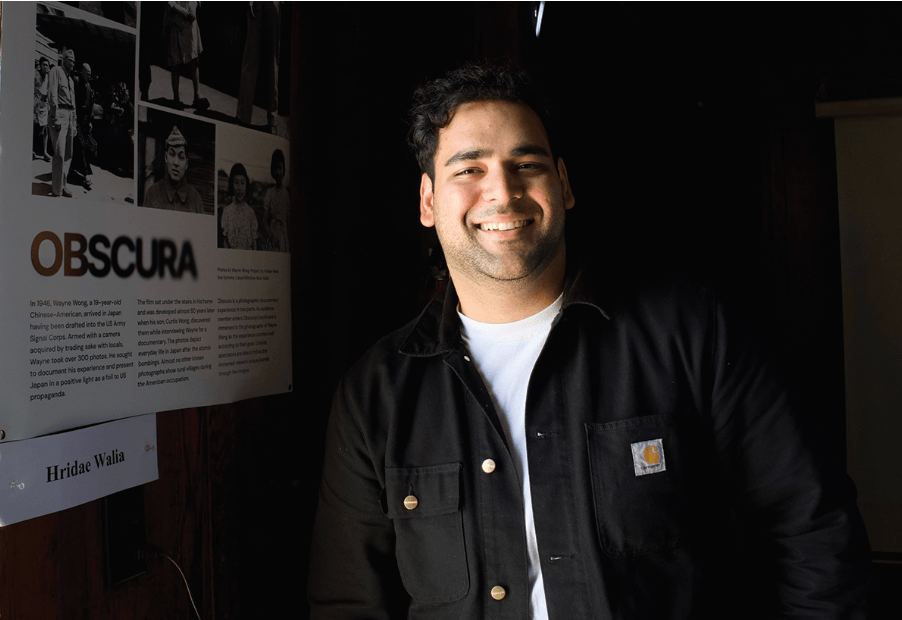
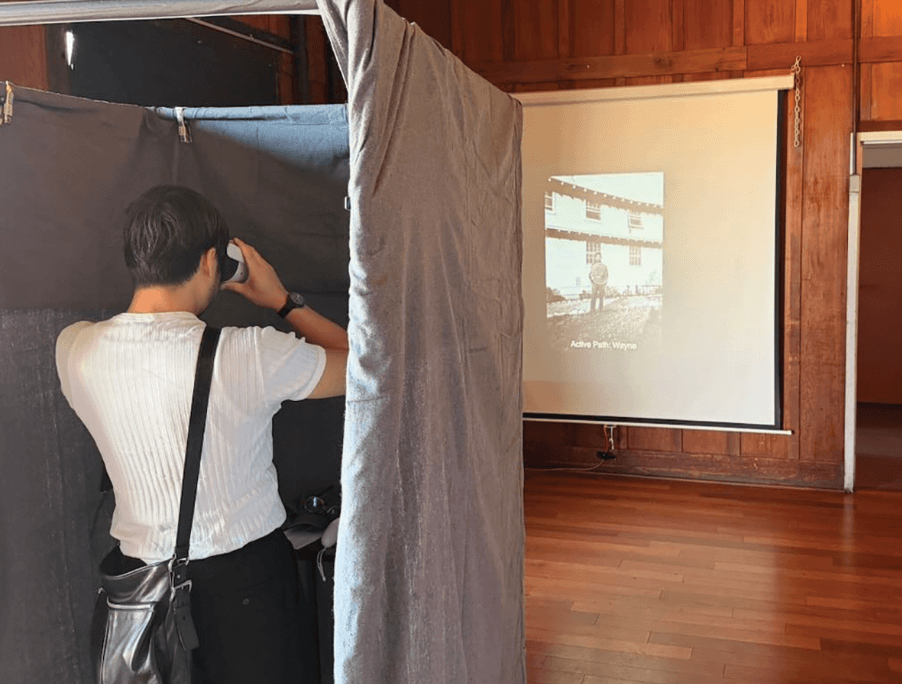
In September, as part of an inaugural art show, visitors to the Potrero Hill Neighborhood House stepped inside a makeshift enclosure, put on a virtual reality headset and looked through photographs taken roughly 80 years ago in postwar Japan. A projection visible to those outside the closure displayed the images the participant was viewing and traced where their attention lingered. One person might focus on a face; another could loiter on clothing, architecture or a detail in the background.
The difference in what’s noticed is central to Obscura, an interactive installation led by designer Hridae Walia that asks viewers not only to examine an unusual photographic archive, but to consider how distinctly people can experience the same images.
The idea for Obscura emerged when Walia and his collaborators – Nicholas Hallin, Caiya Wiltshire, and Asa Symons – were students in the University of Washington’s Master of Human-Computer Interaction + Design program. Seattle’s Museum of History & Industry presented the group with an archive of more than 300 photographs taken in Japan following World War II and challenged them to do something “boundary pushing” with it. The team explored in excess of 100 concepts before arriving at Obscura.
“Three hundred photos presented statically is either really boring or takes up a lot of space,” Walia said. “We wanted to make something that is a more involved experience than a traditional archive of images would suggest.”
The photographs were taken by Wayne Wong, a 19-year-old Chinese American serviceman drafted into the U.S. Army Signal Corps and sent to Japan following the war. An avid photographer, Wong documented ordinary life using his own Rolleicord camera and later a Leica he acquired by trading his ration of sake. Rather than focusing solely on military activity or destruction, his images show children, workers, villagers and families navigating the war’s aftereffects.
“The fact that Wayne captured quotidian life in such a unique and violent point in history is what makes these photos so special,” Walia said. “They answer questions like, what was it like to get married in the aftermath of your country getting nuclear bombed, how were kids going to school?”
Wong provided no explanation of what he intended viewers to see. Instead of attempting to answer that question for him, Walia and his team decided to investigate what contemporary viewers saw in the photographs. The group spread the entire collection across a large table and invited Asian American, Japanese and Japanese American participants, as well as children of war veterans, to examine the photos and describe what they noticed, thought and felt.
One participant was angered by the sight of an American flag at a Japanese airfield. Another felt sadness looking at people resuming their lives after the war. A daughter of a veteran reflected on how little her father had spoken about his wartime experiences.
“We found that people largely paid attention to different photos and had different thoughts based on their background,” Walia said.
Those conversations shaped Obscura’s unusual two-audience format. While one person is immersed in the archive, those outside the installation can follow their gaze.
“I wonder what I would look at if I tried this,” he said, describing reactions he hoped to provoke. “I want to ask this person why they were looking at clothing, because I was paying attention to their faces.”
As visitors move through the exhibition, the set of displayed photographs dynamically shifts and evolves based on real-time biometric tracking. Heat maps indicate where a gaze lingered longest, altering which images stay on the walls and which fade away. After the experience, participants receive a photo strip reflecting the images and details that held their extended attention. The strips are both souvenirs and conversation starters.
“If two people experience Obscura, while looking at each other’s gaze, and then afterwards are seen talking and comparing each other’s photo strips, that’s a home run,” Walia said.
Friends have emerged from the installation and discovered that while one concentrated on faces, the other studied clothing. Their personalized strips allow them to see photographs selected for the other person that they may not have encountered during their own journey.
Visitors have occasionally become more absorbed than Walia anticipated. Initially, Obscura had no time limit. Participants remained inside for extended periods, continually following the changing photographs without realizing that others were waiting. One guest described the immersed experience as so isolating that it was easy to lose awareness of the room outside.
Walia ultimately shortened each session to roughly 90 seconds, enough time for what he described as a coherent “run,” while allowing visitors to experience it again if they choose. That adjustment illustrates a tension running throughout Obscura. The project relies on virtual reality, eye tracking and personalization, but its designers are attempting to generate something decidedly human: conversation.
According to Walia, Wong spoke little about his wartime experiences after returning home. His photographs were archived for decades, a silence Walia said echoed interviews the team conducted with children of other veterans. That absence became part of the project’s inspiration. Rather than offer a definitive interpretation of Wong’s photographs, Obscura creates opportunities for people to explain their own.
“My hope for what people take away from the experience is how ‘normal’ it all can seem even in the aftermath of something so devastating,” Walia said.
One participant summarized that sensation during the project’s development in three words:
“Life goes on.”
People rebuild. Children return to school. Adults return to work. People marry, raise families and continue living.
 Rebekah Moan
 Moumita Chakraborty
 Jessica Zimmer
