
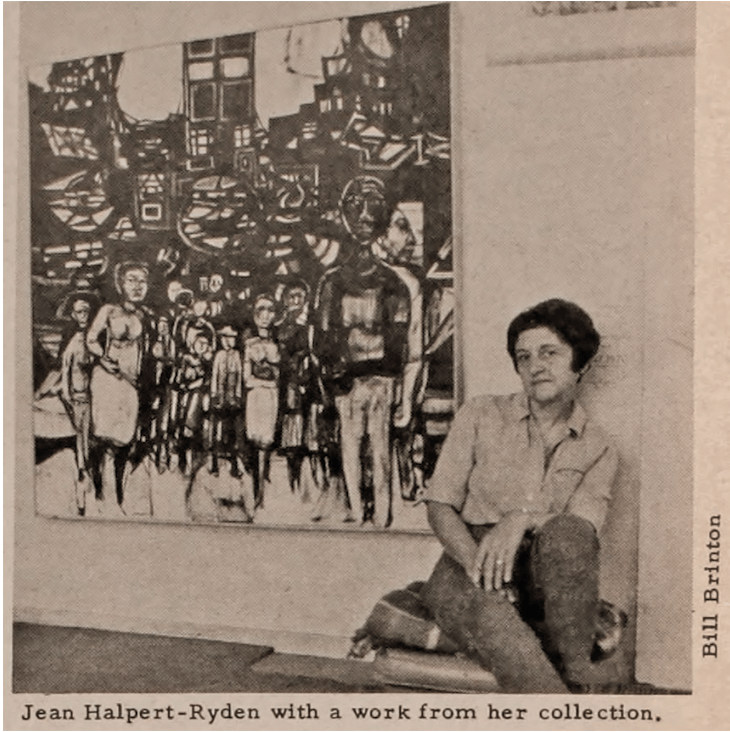
In August 1971, The Potrero View published “Artists and the Community,” which included Jean Halpert-Ryden, photographed by Bill Brinton seated in front of a large painting at an exhibit or in her 778 Kansas Street studio. She’d lived on the Hill for more than a decade, serving as a Potrero Hill Residents and Homeowners Council board member.
“I believe that art occurs when content and form inter-penetrate so thoroughly that one can find neither end nor beginning,” she told the View, “…and that in this complete synthesis must lie the bittersweet quality of life itself.”
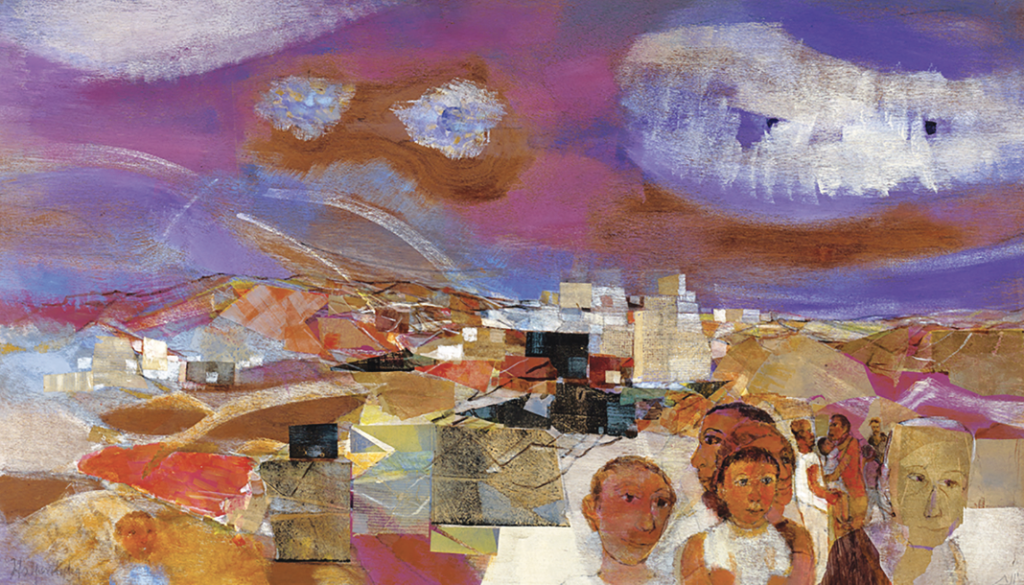
Fifty-five years later, Jean Halpert-Ryden’s art has largely disappeared from public view. This is the story of it’s return.
Halpert-Ryden was born in Brooklyn in 1919. She studied art in New York in the 1940s under a private teacher, and in 1947 married Edward Ryden, a printmaker and sculptor. They arrived in San Francisco in the late 1940s and, in 1958, purchased a cottage on Kansas Street, which Ryden remodeled into a modern three-story home, studio, and workshop.
Halpert-Ryden maintained the Kansas Street studio into the 1970s. She won prizes at the San Francisco Women Artists annual exhibitions; the organization that’d championed Georgia O’Keeffe and Dorothea Lange. She received an award from the Society of Motion Picture Art Directors, with the work exhibited at the Los Angeles County Museum of History, Science and Art, now known as LACMA. She showed collages and paintings at the City of Paris, San Francisco’s Rotunda Gallery. She obtained a cash prize from the San Francisco Art Association, exhibiting alongside Richard Diebenkorn, David Park, Elmer Bischoff, and Nathan Oliveira.
In 1959, the California Palace of the Legion of Honor gave her a solo exhibition; 35 works. The catalog cover featured a painting of a child against a San Francisco cityscape. The curator’s note described a painter grappling with the human figure in an urban environment. In 1962, the inaugural issue of Artforum magazine — launched in San Francisco before moving to New York — critically reviewed her work. She was being taken seriously.
Thomas Albright, chronicler of Bay Area postwar art, included her in his 1985 survey Art in the San Francisco Bay Area, 1945–1980, published by UC Press. He compared her painting to Max Beckmann. Her work entered institutional collections: the San Francisco Arts Commission, IBM, Kaiser Center. A painting took third place — and a $750 prize — in an international competition, entering the permanent collection of the Adam Mickiewicz Museum of Literature in Warsaw, Poland.
At the Kansas Street studio Halpert-Ryden painted a Holocaust memorial series which she first initiated in 1943, as the extent of the Nazi genocide was becoming known to the world. She continued that series for more than three decades, completing it in 1976 with a large mixed-media collage titled Memorial for the Unfulfilled.
In 1963, Halpert-Ryden gave a public talk titled “A Place for the Artist in a World of Crisis?” which was noted in an FBI domestic surveillance file as part of its investigations into the peace movement.
In 1985, Jean and Ed moved to Israel. She continued to paint there; large canvases of the Israeli landscape, crowd scenes, imagery. She was living in Israel when the 1991 Gulf War began. She painted that too: a large mixed-media work, Missiles — The Gulf War, that brought the human figure back to center after years of spatial abstraction.
She returned to California in 2002, when Alzheimer’s had taken hold. She died in Santa Rosa in March 2011. There was no estate, no gallery advocacy, no archive readily accessible to the public. In 2022, dozens of works from Halpert-Ryden’s personal collection surfaced at a sale at the Sebastopol Center for the Arts. They were sold as part of a broader estate dispersal; not as a collection, not with context, nor with any indication of who Halpert-Ryden was or what her work represented. Several buyers purchased pieces simultaneously without realizing some of the works belonged together. Two triptychs separated.
I purchased forty of those works. Over the next three years I built an archival record from scratch: Smithsonian Archives of American Art, Museum of Modern Art Library in New York Legion of Honor catalog, San Francisco Art Association newsletters at the Internet Archive, Artforum archives, University of California, Berkeley Bancroft Library. The picture that emerged was of a painter who’d been present in the Bay Area art world for thirty years — reviewed, exhibited, collected, compared to Beckmann — and who’d been left behind when the canonical narratives of that period were written.
I acquired two additional works from Calabi Gallery in Sebastopol. One more turned up at Rick Petteford’s antique shop on Gravenstein Highway; an unsigned urban pastel from 1953, with Halpert-Ryden’s catalog notation on the verso. The collection now stands at forty-four pieces, spanning 1948 to 1998; the full arc of her documented practice.
There may be people on Potrero Hill — or those who knew the Hill in those decades — who remember Halpert-Ryden, who have a piece of her work on a wall, who know something about 778 Kansas Street that the archives don’t record. I’d be glad to hear from you. The research portal is at jeanhalpertrydenart.com.
Dana Pearlman is the cultural steward of the Jean Halpert-Ryden collection. She lives in Sebastopol, California.
 Moumita Chakraborty
  Jessica Zimmer
  Mark Steensland